Cyber Resilience Act Timeline: Key Dates 2026-2027
Cyber Resilience Act key dates: reporting has applied since 11 September 2026 and main obligations apply from 11 December 2027.

In this article
As of 9 August 2026, the Commission's CRA conformity page says NANDO will list CRA notified bodies once available. No CRA harmonised standard has been published in the Official Journal. The ENISA reporting platform went operational on 11 September 2026, when mandatory vulnerability and incident reporting started.
If you manufacture products with digital elements for the EU market, this is the actual situation: what you must build now, what is currently blocked, and why Important Class I self-assessment is not available yet for many products.
Summary
Since 11 June 2026, Member States can formally notify conformity assessment bodies to the Commission for the CRA. It is not a manufacturer deadline. NANDO still lists no CRA-designated notified bodies as of 9 August 2026. That means you cannot start a CRA notified-body assessment until a body is formally listed for the CRA.
Timeline at a glance
- Past milestone
- Enforcement milestone
- Final deadline
- Ecosystem milestone
State of play on 9 August 2026, against the two anchor dates that bind manufacturers.
Date reference
| Date | Milestone | Who it affects |
|---|---|---|
| 10 Dec 2024 | CRA enters into force | All manufacturers, importers, and distributors |
| 11 Jun 2026 | Notified-body notification machinery opens | Member States and conformity assessment bodies |
| 11 Sep 2026 | Vulnerability and incident reporting mandatory | Manufacturers |
| 11 Dec 2026 | Commission target for sufficient notified-body capacity | Ecosystem context |
| 11 Dec 2027 | Full CRA application | Manufacturers, importers, distributors |
Three blockers you cannot work around
Harmonised standards, designated notified bodies, and the ENISA reporting platform are all in flight. Until they land, parts of the CRA route are formally unavailable, regardless of how ready your product is. Know these before finalising your timeline.
No harmonised standards
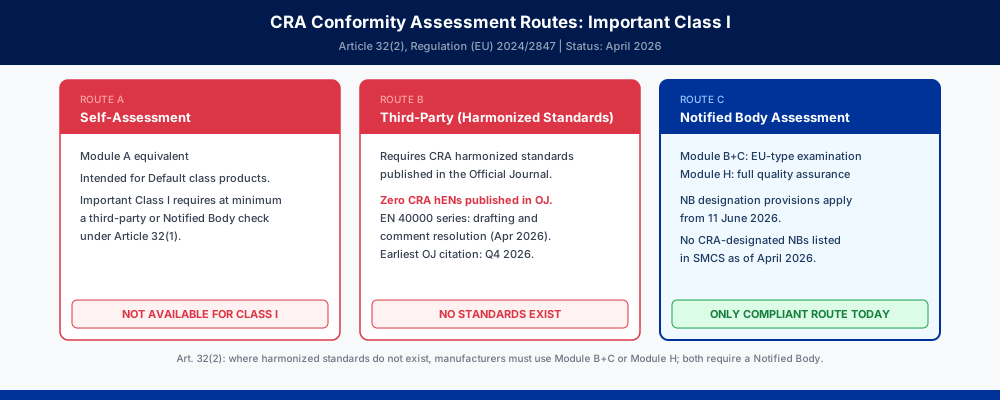
Important Class I manufacturers have three conformity routes: self-assessment, a third-party assessment using harmonised standards or common specifications, or notified-body assessment. The first two routes depend on standards or specifications that are not available yet. As of 9 August 2026:
- The Commission's harmonised standards page has no entry for Regulation (EU) 2024/2847.
- No common specifications have been adopted for the CRA.
- No delegated act designates any European cybersecurity certification scheme as a CRA presumption-of-conformity route.
Where standards do not exist, the fallback route is Module B+C (EU-type examination) or Module H (full quality assurance). Both require a notified body.
So if you manufacture an Important Class I product, do not plan around self-assessment until the relevant standard route exists. For now, notified-body assessment is the only route available for products that cannot use another presumption-of-conformity route.
CEN-CLC/JTC 13/WG 9 is developing the EN 40000-1 parts. Status on 2 October 2026:
- EN 40000-1-1 (Vocabulary): approved in the CEN-CENELEC formal vote. Ratification is scheduled for 2 November 2026.
- EN 40000-1-2 (Principles, product risk management, and lifecycle activities): approved in the formal vote. Ratification is scheduled for 2 November 2026.
- CEN-CENELEC records "No citation expected" in the Official Journal for both. They give no presumption of conformity, so they do not change the Class I picture above.
- prEN 40000-1-3 (Vulnerability Handling): public enquiry ran December 2025 to February 2026. It is under approval, and CEN-CENELEC expects it to be cited.
- prEN 40000-1-4 (Generic Security Requirements): still in drafting.
- The 17 ETSI Type-C verticals are in ETSI's approval procedure. All 17 enquiry drafts are in its public folder.
No CRA standard has a confirmed Official Journal citation date. The first two ratifications, scheduled for 2 November 2026, concern the two parts that CEN-CENELEC does not expect to be cited.
No notified bodies
Chapter IV has applied since 11 June 2026. The Commission's target is sufficient notified-body capacity by 11 December 2026, but that is a best-efforts target, not a guarantee for every product category. As of 9 August 2026, no CRA-designated notified bodies appear in NANDO.
If you need an Important Class I assessment completed before December 2027, plan for:
- Technical file preparation: 3 to 6 months.
- Module B+C assessment: 2 to 4 months per product.
- Notified-body availability: uncertain now that formal designation under Chapter IV has opened.
Contact conformity assessment bodies now. The formal machinery has opened, but CRA capacity is still not listed in NANDO. Waiting for capacity to mature makes completing your assessment before December 2027 less likely.
ENISA platform preparation
The Single Reporting Platform has been open since 11 September 2026 at portal.cra-srp.enisa.europa.eu. On the landing page you select the Assigned Representative role and sign in with EU Login. EU Login accounts are personal and must have multi-factor authentication enabled. ENISA refreshed its FAQ and registration guide on 10 September 2026 and its interface and notification guides on 9 September 2026, alongside a Glossary at version 1.3 and a list of coordinator CSIRTs dated 10 September. On 9 September 2026 it also published a 55-page AR User Manual covering every screen. They cover the Assigned Representative, the SRP account role that files on a manufacturer's behalf, so they apply whether or not you have appointed an authorised representative. ENISA still marks all of it as current best knowledge and subject to change. See ENISA SRP onboarding.
What you can do now:
- Draft notification templates for the 24-hour and 72-hour stages, the 14-day vulnerability final report, and the one-month severe-incident final report.
- Identify your member state's designated CSIRT coordinator.
- Define who internally can authorise a 24-hour notification on a weekend or public holiday.
Open the ENISA Single Reporting Platform page.
What must be in place to report
If these items are not done, the reporting process is not ready. Build the operational controls now.
Product inventory and classification
You need a complete list of every product with digital elements (PDE) you place on the EU market, with CRA classification confirmed for each product:
- Default class: Self-assessment route available.
- Important Class I: notified-body assessment required where the relevant standard route is unavailable.
- Important Class II: notified body required. Module B+C or Module H.
- Critical: Module B+C or full quality assurance. European cybersecurity certification may also apply.
Classification reference: Implementing Regulation (EU) 2025/2392 (OJ 1 December 2025, in force 21 December 2025) provides technical descriptions of Annex III and IV product categories. Use it to resolve edge cases.
SBOM infrastructure
You cannot report an actively exploited vulnerability within 24 hours if you do not know what components your product contains. SBOM generation must be operational.
- Format: CycloneDX or SPDX. Both are accepted under CRA. Pick one and standardise across products.
- Scope: Transitive dependencies, not direct dependencies only. Full component visibility is required for the Annex VII risk assessment.
- Storage: Version-controlled, tied to product releases. Each SBOM must map to a specific build.
- Integration: CI/CD pipeline. A one-time export does not satisfy the ongoing obligation.
Vulnerability monitoring
The 24-hour reporting clock starts at awareness: reasonable certainty based on an initial assessment. Forensic confirmation is not required to trigger the clock. You need monitoring capable of producing that initial assessment before the deadline runs.
- Subscribe to NVD, OSV, and relevant vendor advisories for your component stack.
- Automate scanning against your SBOM components.
- Document your internal escalation path and test it end-to-end.
- Draft notification templates now, before you need them.
Readiness checklist
PRODUCT INVENTORY (do this first: classification drives your conformity route):
[ ] Complete list of PDEs sold in EU with CRA classification confirmed per product
[ ] Important Class I products: conformity assessment body engaged now. Formal designation
    has opened, but CRA notified-body capacity is not listed in NANDO yet
[ ] Support period declared based on expected product lifetime

SBOM (start here: feeds monitoring, technical file, and 24-hour reporting):
[ ] SBOM generation integrated in CI/CD pipeline. A one-time export is not enough
[ ] Format standardised: CycloneDX or SPDX
[ ] Transitive dependency coverage verified. Direct dependencies alone are not enough
[ ] SBOMs version-controlled and tied to specific product releases

VULNERABILITY MONITORING (must be live now):
[ ] Monitoring active for all products: NVD, OSV, vendor advisories
[ ] Automated scanning against SBOM running
[ ] Internal escalation path documented and tested end-to-end
[ ] 24/7 coverage confirmed, including holiday and weekend escalation paths

REPORTING PREPARATION (the ENISA platform is live: have these ready):
[ ] 24-hour, 72-hour, 14-day vulnerability, and one-month incident templates drafted
[ ] Member state CSIRT coordinator identified
[ ] Person authorised to trigger a 24-hour notification named and reachable around the clock

DOCUMENTATION:
[ ] Technical documentation audited against Annex VII
[ ] Gap analysis complete
[ ] Risk assessment underway
What reporting requires
Since 11 September 2026, you must report actively exploited vulnerabilities and severe incidents through the Single Reporting Platform. The report goes to your member state's designated CSIRT coordinator and is made available to ENISA at the same time, unless exceptional disclosure-delay rules apply.
| Timeframe | What you must be ready to send |
|---|---|
| 24 hours | Early warning after becoming aware of an actively exploited vulnerability |
| 72 hours | Full vulnerability notification with technical indicators |
| 14 days | Final report after a corrective or mitigating measure is available |
| 1 month | Final incident report for severe incidents |
What "actively exploited" means
Active exploitation means a threat actor has used the vulnerability in a system without the owner's permission. Indicators include:
- Confirmed attacks observed in the wild.
- Exploitation reported in threat intelligence feeds or by security researchers.
- Detection in honeypots with evidence of active deployment.
The Commission's July 2026 draft guidance says a manufacturer becomes aware after an initial assessment gives it a reasonable degree of certainty that active exploitation has occurred. Full forensic confirmation is not required.
Reporting readiness checklist
REPORTING INFRASTRUCTURE (in place before you file):
[ ] Notification templates prepared: 24-hour, 72-hour, 14-day vulnerability, and one-month incident formats
[ ] Member state CSIRT coordinator identified. This is your primary submission point
    alongside ENISA
[ ] 24/7 escalation path confirmed, including holiday coverage and backup contacts
[ ] Legal review of reporting obligations completed

VULNERABILITY MANAGEMENT:
[ ] Active monitoring operational for all products
[ ] CVE/NVD integration live
[ ] Customer notification templates ready

TEAM READINESS:
[ ] Security team trained on the four-stage reporting timeline
[ ] Management escalation path documented
[ ] Legal team briefed on reporting obligations
[ ] Communications team prepared for public disclosures
Full compliance by 11 December 2027
Essential cybersecurity requirements
Every compliant PDE must meet these requirements:
Security by design
- Security level appropriate to the product's risks (Annex I, Part I, §1).
- Protection against unauthorised access.
- Confidentiality, integrity, and availability of data and essential functions.
- Minimal attack surface, secure defaults, no hardcoded credentials.
Vulnerability Management
- Documented process for identifying and addressing vulnerabilities.
- Timely, free security updates during the support period.
- Coordinated vulnerability disclosure policy.
Update Capability
- Secure, reliable update mechanism.
- Ability to separate security updates from feature updates.
Technical documentation
| Document | Requirement |
|---|---|
| Risk assessment | Identifies and addresses cybersecurity risks for the product |
| SBOM | Complete component inventory with versions |
| Conformity evidence | Demonstrates compliance with Annex I requirements |
| Vulnerability procedures | Documents handling processes |
| Support period declaration | Specifies support period based on expected product lifetime |
Support period: two separate obligations
The CRA imposes two distinct obligations on security updates.
Support duration: You must issue security updates for a minimum of five years from the date of placing the product on the market, or for the expected product lifetime if shorter. Five years is the floor, not the default. A product with a 10-year expected lifetime needs a 10-year support commitment.
Update availability: Each security update you issue must remain available for download for a minimum of 10 years from the issuance date, or for the remainder of the support period, whichever is longer.
These are independent obligations. An update issued in year four of a five-year support period must remain downloadable until year 14 from issuance. If you delete old update packages or let distribution infrastructure lapse, you can breach the update-availability rule even while issuing new updates on schedule. Plan your storage and distribution infrastructure for the long haul before you issue your first update under the CRA.
December 2027 Checklist
PRODUCT COMPLIANCE:
[ ] All products meet Annex I requirements: security by design, vulnerability management,
    and update capability
[ ] Conformity assessments complete: notified-body process finished for Important Class I and Class II
[ ] CE marking applied
[ ] EU declaration of conformity prepared

TECHNICAL FILE (Annex VII):
[ ] Risk assessment complete and documented
[ ] SBOM current and validated
[ ] Conformity evidence organised and accessible
[ ] Support period declared based on expected product lifetime

MARKET CHAIN:
[ ] Importers and distributors informed of their CRA obligations
[ ] Customer-facing documentation updated

ONGOING:
[ ] Security update process active for the full support period duration
[ ] Update availability infrastructure in place. 10 years from each issuance date
[ ] Vulnerability monitoring active and tested
[ ] Incident response exercised at least quarterly
Commission guidance: July 2026 draft
On 27 July 2026, the Commission approved and published the content of draft guidance C(2026)5252. Formal adoption and applicability await all language versions. For a full breakdown, see our July CRA Commission guidance guide.
Key rulings relevant to your timeline:
RDPS test for SaaS scope: Remote data processing software is in CRA scope only if it passes three conditions. The software performs remote data processing. The remote processing is necessary for the product's core function. And the manufacturer controls the remote processing. SaaS that fails this test is out of scope.
Legacy products: No historical documentation reconstruction is required. You need a present-day risk assessment. Product families may be grouped for risk assessment purposes.
Software updates: An update does not constitute a "substantial modification" that triggers a new conformity assessment unless it introduces new threat vectors or changes the product's intended purpose. The guidance provides a four-question test.
24-hour clock: Starts at awareness. Reasonable certainty based on an initial assessment is enough. Forensic confirmation is not required.
Support period floor: Five years is a minimum, not a default. The support period must reflect the product's expected lifetime.
Open source: Publishing source code does not constitute placing a product on the market. Contributors who do not control the release of a finished product are not manufacturers under the CRA.
Read the Commission announcement.
Penalties
The top CRA penalty tier is €15 million or 2.5% of total worldwide annual turnover, whichever is higher. It applies to:
- Non-compliance with essential cybersecurity requirements and manufacturer obligations.
- Failure to meet vulnerability and incident reporting obligations.
Both categories sit in the same penalty tier. There is no general lower tier for reporting failures.
For the complete fine-tier structure and the market-surveillance measures that can sit alongside fines, see CRA penalties and enforcement.
Industry-specific notes
Consumer electronics
SBOM automation is the highest-value early investment. It feeds directly into vulnerability monitoring and technical file generation. Consumer products typically have complex supply chains with multiple component vendors.
Managing firmware updates across large device populations requires OTA infrastructure. An update issued in year three of a product's life must remain downloadable for 10 years from that issuance date. Plan your distribution infrastructure now, not at the point of issuance.
Software publishers
Vulnerability reporting is the most operationally demanding obligation for software products. Discovery rates are higher, and tracking dependencies at transitive depth in modern stacks is not simple. Integrate SBOM generation into your existing CI/CD pipelines. It feeds directly into monitoring and the response workflow.
Industrial equipment
Industrial products frequently fall into Important Class I or Class II, which currently means notified-body assessment. Contact conformity assessment bodies now. The formal designation process has opened under Chapter IV, and capacity will be constrained through at least December 2026.
IoT devices
Default credential elimination follows from the secure-by-default requirement in Annex I, Part I. Address it first. It is a clear Annex I violation and relatively contained to fix compared to architectural changes. Secure update mechanisms for resource-constrained devices require more work. Start with credentials, then tackle updates.
Frequently Asked Questions
When does the CRA fully apply, and what applies before then?
The CRA entered into force on 10 December 2024, and full application is on 11 December 2027. Two intermediate dates matter for manufacturers. Since 11 September 2026, vulnerability and incident reporting has been mandatory. Since 11 June 2026, Member States can notify conformity assessment bodies for the CRA. That June date is not a manufacturer deadline. To resolve which CRA tier your product sits in before the remaining dates land, see the product classification guide.
Can I self-assess an Important Class I product today?
Not if your route depends on CRA harmonised standards or common specifications. As of 9 August 2026, no CRA harmonised standard is published in the Official Journal, no common specification has been adopted, and no European cybersecurity certification scheme has been designated as a CRA presumption-of-conformity route. That leaves notified-body assessment as the only available route for products that cannot use another conformity route, and NANDO does not yet list any CRA-designated notified body. For the full module breakdown and how to plan around it, see the conformity assessment decision guide.
What happened on 11 September 2026?
Reporting became mandatory. Since that date, manufacturers must report actively exploited vulnerabilities and severe incidents through the Single Reporting Platform. The workflow has four stages: an early warning within 24 hours of awareness, a full vulnerability notification within 72 hours, a final report within 14 days once a corrective measure exists, and a final incident report within 1 month for severe incidents. The 24-hour clock starts at awareness based on an initial assessment, not on forensic confirmation. For a deeper walk through the timeline, see the ENISA vulnerability reporting guide.
Are any notified bodies designated under the CRA yet?
No. Chapter IV has applied since 11 June 2026, which is the date the notification machinery opened for Member States and conformity assessment bodies. The Commission's target is sufficient notified-body capacity by 11 December 2026, but that is a best-efforts target and not a guarantee per Member State. As of 9 August 2026, no CRA-designated notified bodies appear in NANDO. If your product needs an Important Class I or Class II assessment completed before December 2027, treat the designation calendar as a real scheduling risk, not a paperwork detail.
Is there an SME exemption from CRA reporting?
No. Micro and small manufacturers still have to report. The carve-out only removes fines for missing the two 24-hour early-warning deadlines. It does not remove the reporting duty, and it does not reduce the penalty tier for product security, technical documentation, vulnerability handling, or support-period failures. Those failures can still sit in the top CRA bracket: EUR 15 million or 2.5% of worldwide annual turnover, whichever is higher.
Does publishing open-source code make me a manufacturer under the CRA?
No. The Commission's draft guidance says publishing source code does not, by itself, place a product on the market. Contributors who do not control the release of a finished product are not manufacturers under the CRA. The obligation falls on whoever places the product with digital elements on the EU market in the course of a commercial activity. For the full set of rulings in that draft, including the RDPS test for SaaS scope and the substantial-modification test for updates, see the CRA Commission guidance guide.
What is the difference between the five-year support floor and the ten-year update availability rule?
They are two independent obligations. The support-period rule requires you to issue security updates for at least five years from the date the product is placed on the market, or for the expected product lifetime if shorter. Five years is a floor, not a default: a product with a 10-year expected lifetime needs a 10-year support commitment. The update-availability rule requires each individual security update to remain downloadable for at least 10 years from its issuance date, or for the rest of the support period, whichever is longer. An update issued in year four of a five-year support period must remain downloadable until year 14 from issuance.
What should I do this quarter if my product is Important Class I?
Do three things now. First, engage conformity assessment bodies even though CRA capacity is not listed in NANDO yet. Capacity is finite, and formal designation is now open. Second, complete your Annex VII technical file ahead of the assessment, because the file is the input to Module B+C or Module H and it takes 3 to 6 months to assemble cleanly. Third, build SBOM generation into your CI/CD pipeline, since it feeds the technical file, the 24-hour reporting workflow, and any future presumption-of-conformity route. For artefact specifics, see the technical file guide and the SBOM generation guide.
Related Articles
ENISA on Frontier AI: 5 Consequences for the CRA
Does the CRA apply to your product?
Answer up to 11 simple questions to find out if your product falls under the EU Cyber Resilience Act scope. Get your result in under 2 minutes.
Ready to achieve CRA compliance?
Start managing your SBOMs and compliance documentation with CRA Evidence.