CRA for Consumer IoT: EN 303 645 and Smart Home Security
How the CRA applies to consumer IoT: default-category duties; Annex III Class I for smart-home security, social/tracking toys and health/children's wearables.

In this article
- Summary
- Which Consumer IoT Products Are Covered?
- EN 303 645 and CRA Alignment
- Core Requirements Deep Dive
- SBOM for Consumer IoT
- 5-Year Support: The Big Challenge
- Consumer Documentation Requirements
- Conformity Assessment for Consumer IoT
- Industry-Specific Guidance
- Practical Compliance Roadmap
- Checklist for Consumer IoT
- Frequently Asked Questions
- How CRA Evidence Helps
Consumer IoT products (smart speakers, connected cameras, wearables, smart home devices) face the broadest CRA obligations. Most fall into the Default category, allowing self-assessment, but must still meet all essential requirements. ETSI EN 303 645 provides a strong baseline for compliance.
This guide covers CRA compliance for consumer IoT manufacturers.
Tip: Most IoT devices fall into the Default category under the CRA. Check Annex III before assuming third-party assessment is needed.
Summary
- Most consumer IoT products are Default category (self-assessment allowed)
- EN 303 645 provides a strong baseline, but it is not a CRA harmonized standard as of 17 October 2026
- "Secure by default" is critical: no default passwords, minimal exposed services
- 5-year support period is a major shift for many consumer products
- SBOM required even for embedded devices
- Consumer-facing documentation must be in local language
Which Consumer IoT Products Are Covered?
CRA Scope for Consumer IoT
The CRA applies to all "products with digital elements" placed on the EU market. For consumer IoT, this includes:
Clearly in scope:
- Smart speakers and voice assistants
- Smart home hubs and controllers
- Connected cameras (security, baby monitors, doorbells)
- Smart lighting systems
- Connected thermostats and HVAC controls
- Smart locks and access systems
- Wearable devices (smartwatches, fitness trackers)
- Connected toys and games
- Smart appliances (fridges, washing machines)
- E-readers and tablets
- Connected health/wellness devices (non-medical)
Partial scope (may have additional regulations):
- Smart TVs (also covered by RED)
- Connected medical devices (also MDR; see our MDR guide)
- Connected vehicles (type-approved vehicles are excluded under Article 2(2)(c), see our automotive guide)
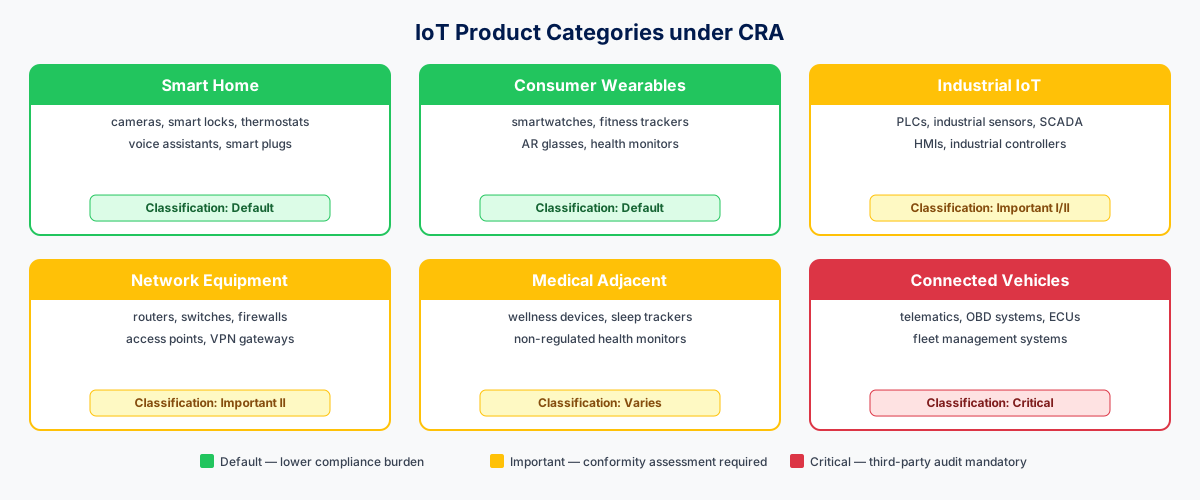
CRA Classification for Consumer IoT
Most consumer IoT falls into Default or Important Class I:
CONSUMER IoT CRA CLASSIFICATION

DEFAULT CATEGORY (Self-assessment):
- Smart speakers WITHOUT a general-purpose virtual assistant
- Connected cameras (non-security purpose, e.g. plain webcam or meeting camera)
- Smart lighting
- Connected thermostats
- Non-health, non-children fitness bands
- Smart appliances
- Connected toys with no social interactive features and no location tracking
- General smart home devices
- Smart home hubs and home automation gateways without their own security functions
- Parental control software

IMPORTANT CLASS I (Self-assessment with harmonized standards OR third-party):
- Smart speakers WITH a general-purpose virtual assistant
- Security cameras, baby monitors, alarm systems, smart door locks
- Internet-connected toys (Directive 2009/48/EC) with social interactive features (speaking/filming) or location tracking
- Health-monitoring wearables not covered by MDR/IVDR, and any wearable intended for/by children
- Consumer VPN solutions
- Password managers

IMPORTANT CLASS II (Third-party required):
- Consumer firewalls
- Consumer IDS/IPS devices
- (Rare for pure consumer products)
EN 303 645 and CRA Alignment
What Is EN 303 645?
ETSI EN 303 645 "Cyber Security for Consumer Internet of Things: Baseline Requirements" is the leading standard for consumer IoT security. Published in 2020, it is widely adopted as a consumer IoT baseline. As of 17 October 2026, it has not been listed as a CRA harmonized standard.
EN 303 645 Structure:
- 13 provision categories
- 66 mandatory provisions (for baseline compliance)
- Additional recommendations
- Companion test specification (TS 103 701)
EN 303 645 ↔ CRA Mapping
| CRA Essential Requirement | EN 303 645 Provision | Coverage |
|---|---|---|
| No known vulnerabilities | 5.2 (vulnerability disclosure) | Partial |
| Secure by default | 5.1 (no universal passwords) | Strong |
| Protection from unauthorized access | 5.1, 5.5, 5.6 | Strong |
| Confidentiality of data | 5.8 (personal data security) | Strong |
| Data integrity | 5.4 (secure communication) | Strong |
| Minimal data collection | 5.8.2 (data minimization) | Good |
| Resilience and mitigation | 5.3, 5.6 (software updates, security) | Good |
| Incident effects minimization | 5.6 (resilience) | Partial |
| Security updates | 5.3 (software updates) | Strong |
| Update mechanism | 5.3.3 (update mechanism) | Strong |
| Vulnerability handling | 5.2 (vulnerability disclosure) | Strong |
| SBOM | Not covered | Gap |
| Support period disclosure | 5.3.1 (support period) | Strong |
| Reporting to ENISA | Not covered | Gap |
EN 303 645 as Compliance Foundation
Info: EN 303 645 is widely used as a best-practice baseline, but it is not a CRA harmonized standard as of 17 October 2026. Applying it does not create presumption of conformity under the CRA.
Current status: CRA harmonized standards are being developed under the M/606 mandate. Until they are cited in the Official Journal, EN 303 645 remains supporting evidence rather than a presumption-of-conformity route under the CRA.
What EN 303 645 provides:
- Security baseline
- Testable provisions (TS 103 701)
- Industry recognition
- Existing certification programs
What CRA adds beyond EN 303 645:
- SBOM requirements
- ENISA vulnerability reporting (24h/72h)
- CE marking procedures
- Formal Declaration of Conformity
- Technical file documentation
- Market surveillance coordination
EN 303 645 → CRA COMPLIANCE APPROACH

IF you have EN 303 645 compliance:
→ Strong technical baseline achieved
→ Use assessment evidence for CRA technical file
→ Add SBOM generation
→ Implement ENISA reporting
→ Prepare CE marking documentation

IF starting fresh:
→ Use EN 303 645 as your technical target
→ Plan for CRA additions from the start
→ Consider EN 303 645 certification
Core Requirements Deep Dive
No Default Passwords (Critical)
EN 303 645 Provision 5.1-1: "Where passwords are used and in any state other than the 'factory default' state, all consumer IoT device passwords shall be unique per device or defined by the user."
CRA Alignment: This is "secure by default" in action.
Implementation:
PASSWORD APPROACHES FOR CONSUMER IoT

OPTION 1: Unique factory password
- Generate unique password per device
- Print on device/packaging
- Store in secure element if available

OPTION 2: User-defined at setup
- Force password creation during setup
- Enforce password complexity
- No "skip" option

OPTION 3: Passwordless authentication
- Bluetooth/WiFi pairing codes
- App-based authentication
- Biometric where appropriate

AVOID:
✗ Universal default passwords ("admin/admin")
✗ Predictable passwords (serial number)
✗ Optional password setting
✗ Easy-to-guess patterns
Vulnerability Disclosure
EN 303 645 Provision 5.2-1: "The manufacturer shall provide a public point of contact as part of a vulnerability disclosure policy..."
CRA Enhancement: CRA requires not just disclosure acceptance but active reporting to ENISA.
Implementation:
CONSUMER IoT VULNERABILITY HANDLING

PUBLIC CONTACT:
- security@company.com
- Security.txt file at /.well-known/security.txt
- Dedicated security page on website

DISCLOSURE POLICY:
- Accept reports from security researchers
- Acknowledge within 5 business days
- Provide status updates
- Coordinate disclosure timing
- Credit researchers (if desired)

ENISA REPORTING (CRA-specific, Art 14):
Track (a) - Actively exploited vulnerability:
- Early warning within 24 hours of awareness
- Vulnerability notification within 72 hours of awareness
- Final report no later than 14 days after a corrective or mitigating measure is available

Track (b) - Severe incident (impact on security of the product):
- Early warning within 24 hours of awareness
- Incident notification within 72 hours of awareness
- Final report within one month of the incident notification

Use ENISA Single Reporting Platform for both tracks.
Software Updates
EN 303 645 Provisions 5.3: Software updates capability is mandatory.
Key Requirements:
SOFTWARE UPDATE REQUIREMENTS

UPDATE MECHANISM (5.3.3):
[ ] Secure delivery (signed updates)
[ ] Integrity verification
[ ] Rollback protection
[ ] User notification

UPDATE SUPPORT (5.3.1):
[ ] Defined support period
[ ] Published end-of-support date
[ ] At least product's expected lifetime
[ ] CRA: Minimum 5 years

AUTOMATIC UPDATES (5.3.6):
[ ] Configurable auto-update
[ ] User consent mechanism
[ ] Minimal disruption
[ ] Update status visibility
Secure Communication
EN 303 645 Provision 5.4: Encrypt sensitive data in transit.
Implementation:
COMMUNICATION SECURITY

TRANSPORT ENCRYPTION:
- TLS 1.2+ for all cloud communications
- Strong cipher suites
- Certificate validation
- No fallback to unencrypted

LOCAL COMMUNICATION:
- Encrypt local network traffic where feasible
- Secure pairing mechanisms
- Protected setup/configuration flows

AVOID:
✗ Plain HTTP for any sensitive data
✗ Self-signed certificates without pinning
✗ Weak cipher negotiation
✗ Hardcoded credentials in communications
SBOM for Consumer IoT
Embedded Device Challenges
Consumer IoT devices often run on constrained hardware:
Typical Components:
- Real-time OS or embedded Linux
- Network stacks (lwIP, etc.)
- Protocol libraries (MQTT, CoAP)
- Crypto libraries
- Third-party SDKs (cloud connectivity)
- Application code
SBOM Strategy:
CONSUMER IoT SBOM APPROACH

MINIMUM DEPTH:
1. Operating system/RTOS
2. Major framework/SDK
3. Network/protocol libraries
4. Crypto libraries
5. Cloud connectivity SDK
6. Key third-party components

FORMAT:
- CycloneDX or SPDX
- Include version information
- Include PURL where available
- Document proprietary components

PRACTICAL TIPS:
- Extract from build system
- Automate SBOM generation in CI/CD
- Update SBOM with each firmware release
- Consider tooling (Syft, Trivy, etc.)
Supply Chain Considerations
Consumer IoT often uses common silicon vendors and SDKs:
SUPPLY CHAIN SBOM MANAGEMENT

SILICON VENDOR SDK:
- Request SBOM from vendor (Espressif, Nordic, etc.)
- Many now provide component lists
- Include in your aggregated SBOM

CLOUD PLATFORM SDK:
- AWS IoT, Azure IoT, Google Cloud IoT SDKs
- Well-documented components
- Usually have dependency manifests

THIRD-PARTY MODULES:
- WiFi/Bluetooth modules may have firmware
- Request component information
- Document what you know

DOCUMENT LIMITATIONS:
- Note any components without SBOM visibility
- Explain supply chain constraints
- Update as information becomes available
5-Year Support: The Big Challenge
Industry Context
Many consumer IoT products have historically had short support windows:
- Budget devices: 1-2 years (or no updates)
- Mid-range: 2-3 years
- Premium: 3-5 years
CRA Requirement: Security updates for the declared support period, which is at least 5 years unless the product is expected to be in use for less time (Article 13(8)).
Planning for 5-Year Support
5-YEAR SUPPORT STRATEGY

COST PLANNING:
- Security monitoring (ongoing)
- Vulnerability response capability
- Update development and testing
- Update delivery infrastructure
- Customer support resources

TECHNICAL PLANNING:
- Stable update mechanism
- OTA infrastructure
- Rollback capability
- Testing across device lifetime

COMMERCIAL PLANNING:
- Product pricing (include support costs)
- Support period communication
- End-of-support process
- Customer migration path

LIFECYCLE STAGES:
Year 1-2: Active development, frequent updates
Year 3-4: Maintenance mode, security-only updates
Year 5:   End-of-support preparation
Year 5+:  Support ends, customer notification
End-of-Support Communication
END-OF-SUPPORT REQUIREMENTS

AT PURCHASE:
- Clear support period indication
- Expected end-of-support date
- What "support" includes

APPROACHING END:
- Advance notification (6-12 months)
- Explanation of implications
- Upgrade/replacement options

AT END-OF-SUPPORT:
- Final notification
- Security recommendations
- Safe disposal guidance

POST-SUPPORT:
- Device may still function
- No security updates
- Customer assumes risk
Consumer Documentation Requirements
Language Requirements
Consumer products sold in EU member states require local language documentation:
CONSUMER IoT DOCUMENTATION LANGUAGES

REQUIRED PER MARKET:
- Safety information: Must be in local language
- Setup instructions: Should be in local language
- User manual: Should be in local language

PRACTICAL APPROACH:
- English as base
- Localize for major markets (DE, FR, ES, IT, PL, NL)
- Consider digital documentation (app, QR code)
- Printed quick-start in multiple languages
What to Document
CONSUMER IoT USER DOCUMENTATION

SECURITY INFORMATION:
[ ] Initial setup security (password, pairing)
[ ] Update settings and recommendations
[ ] Privacy settings
[ ] Data collection explanation
[ ] Support period and contact

SAFETY INFORMATION:
[ ] Electrical safety
[ ] Intended use
[ ] Hazard warnings
[ ] Children's safety (if relevant)

COMPLIANCE INFORMATION:
[ ] CE marking visible on product
[ ] Declaration of Conformity reference
[ ] Manufacturer contact information
[ ] Support/security contact
Conformity Assessment for Consumer IoT
Self-Assessment (Module A)
Most consumer IoT can use self-assessment:
MODULE A FOR CONSUMER IoT

WHAT YOU DO:
1. Perform internal risk assessment
2. Implement essential requirements
3. Prepare technical documentation
4. Test against requirements
5. Complete EU Declaration of Conformity
6. Apply CE marking

NO NOTIFIED BODY NEEDED:
- Default category products
- Important Class I with harmonized standards

TECHNICAL FILE CONTENTS:
- Product description
- Risk assessment
- Design documentation
- Test reports (internal or external lab)
- EN 303 645 assessment (if claimed)
- SBOM
- User documentation
Using EN 303 645 Certification
If you pursue EN 303 645 certification:
EN 303 645 CERTIFICATION → CRA

CERTIFICATION BODIES:
- CTIA (US)
- TÜV (EU)
- BSI Kitemark (UK)
- Various ETSI-aligned labs

BENEFITS:
- Third-party verification
- Marketing value ("certified secure")
- Evidence for technical file, but no CRA presumption of conformity unless a CRA harmonized standard is formally cited

FOR CRA, ALSO NEED:
- SBOM (not covered by EN 303 645)
- ENISA reporting process
- Formal EU DoC
- CE marking process
Industry-Specific Guidance
Smart Speakers and Voice Assistants
SMART SPEAKER CRA COMPLIANCE

CLASSIFICATION: Important Class I (Annex III Class I item 16) if the device includes a
general-purpose virtual assistant. A speaker with no general-purpose assistant function
stays Default.

KEY REQUIREMENTS:
- Voice data protection
- Secure cloud communication
- Mute/privacy mode (secure by default)
- Update mechanism
- Account security

PRIVACY CONSIDERATIONS:
- Minimize always-on listening
- Clear indicator when listening
- User data access and deletion
- GDPR alignment
Connected Cameras
CONNECTED CAMERA CRA COMPLIANCE

CLASSIFICATION: Important Class I (Annex III Class I item 17) for security cameras, baby
monitors, and alarm systems. A plain webcam or meeting camera with no security function
stays Default.

KEY REQUIREMENTS:
- Strong authentication
- Encrypted video streams
- Local storage security
- Cloud storage security
- Privacy masking features

SPECIAL CONSIDERATIONS:
- Video data is highly sensitive
- Physical access protection
- Guest/family access management
- Recording notification requirements
Smart Home Hubs
SMART HOME HUB CRA COMPLIANCE

CLASSIFICATION: Default, unless the hub provides its own security functions
(smart door locks, security cameras, alarm systems), which bring it under
Annex III Class I item 17

KEY REQUIREMENTS:
- Protocol security (Zigbee, Z-Wave, Thread, Matter)
- Secure device onboarding
- Access control for connected devices
- Local vs. cloud processing
- Update mechanism for hub and protocols

SPECIAL CONSIDERATIONS:
- Hub is attack surface for all connected devices
- Matter/Thread security alignment
- Backup/recovery capability
Wearables
WEARABLE DEVICE CRA COMPLIANCE

CLASSIFICATION: Important Class I (Annex III Class I item 19) for health-monitoring
wearables not covered by MDR/IVDR, and for any wearable intended for/by children.
Non-health, non-children fitness bands stay Default.

KEY REQUIREMENTS:
- Bluetooth pairing security
- Health data protection
- Phone app security
- Limited attack surface
- Battery-conscious security

SPECIAL CONSIDERATIONS:
- Size constraints affect security features
- Companion app is part of product
- Health data may have additional regulations
Connected Toys
CONNECTED TOY CRA COMPLIANCE

CLASSIFICATION: Important Class I (Annex III Class I item 18) for internet-connected toys
covered by Directive 2009/48/EC that have social interactive features (speaking or filming)
or location tracking. Connected toys without those features stay Default.

KEY REQUIREMENTS:
- Child privacy protection (COPPA-like)
- Parental controls
- Safe default settings
- Simple security model
- Appropriate content filtering

SPECIAL CONSIDERATIONS:
- Children as primary users
- Voice/video features need extra care
- Physical safety + cyber safety
- Clear parental guidance
Practical Compliance Roadmap
Phase 1: Assessment (should already be complete)
CONSUMER IoT ASSESSMENT

PRODUCT INVENTORY:
[ ] List all products with digital elements
[ ] Classify per CRA categories
[ ] Identify products with short current support

GAP ANALYSIS:
[ ] Current vs. EN 303 645 provisions
[ ] SBOM capability
[ ] Update infrastructure
[ ] Support period commitment

PLANNING:
[ ] EN 303 645 compliance path
[ ] SBOM generation tooling
[ ] Support period extension costs
Phase 2: Preparation (should already be complete)
PREPARATION PHASE

TECHNICAL:
[ ] Implement EN 303 645 provisions
[ ] Add SBOM generation to build
[ ] Establish vulnerability handling
[ ] Set up ENISA reporting capability (required since 11 September 2026)

DOCUMENTATION:
[ ] Technical file templates
[ ] User documentation updates
[ ] Multi-language preparation

COMMERCIAL:
[ ] Support period definitions
[ ] Pricing review
[ ] Customer communication plan
Phase 3: Compliance (Sept 2026 - Dec 2027)
COMPLIANCE PHASE

SINCE 11 SEPTEMBER 2026 (in force):
[ ] Vulnerability reporting operational
[ ] EU Login accounts with MFA, coordinator CSIRT chosen
[ ] SRP registration when a notification is due

THROUGH 2027:
[ ] Complete conformity assessments
[ ] Update all product lines
[ ] Finalize documentation
[ ] EN 303 645 certification (optional)

DECEMBER 2027:
[ ] All products CRA compliant
[ ] CE marking applied
[ ] Customer communication complete
Checklist for Consumer IoT
CONSUMER IoT CRA CHECKLIST

PRODUCT SECURITY:
[ ] No default passwords (unique or user-set)
[ ] Encrypted communications (TLS 1.2+)
[ ] Secure update mechanism
[ ] Minimal attack surface
[ ] Secure by default settings

EN 303 645 ALIGNMENT:
[ ] Reviewed all 66 provisions
[ ] Implemented mandatory provisions
[ ] Documented compliance evidence
[ ] Considered certification

SBOM:
[ ] SBOM generation in build process
[ ] All major components identified
[ ] Supply chain components included
[ ] Regular SBOM updates

VULNERABILITY HANDLING:
[ ] Public security contact
[ ] Vulnerability disclosure policy
[ ] ENISA reporting capability
[ ] Patch development process

DOCUMENTATION:
[ ] Technical file prepared
[ ] User documentation updated
[ ] Multi-language support
[ ] Support period stated

SUPPORT PERIOD:
[ ] 5-year minimum commitment
[ ] Update infrastructure planned
[ ] End-of-support process defined
[ ] Cost model sustainable
Frequently Asked Questions
Is EN 303 645 a CRA harmonized standard?
No. As of 17 October 2026, EN 303 645 has not been cited as a CRA harmonized standard in the Official Journal. It remains useful technical evidence for consumer IoT security, but it does not create CRA presumption of conformity.
Can EN 303 645 still help with CRA compliance?
Yes. EN 303 645 covers many baseline consumer IoT controls, including password practices, vulnerability disclosure, updates, and data protection. You still need CRA-specific evidence for SBOMs, Article 14 reporting, CE marking, the EU declaration of conformity, and the technical file.
Do most consumer IoT products need a Notified Body?
Most consumer IoT products are likely to sit in the Default category and can use self-assessment, but classification depends on product function. Password managers, VPN products, and security products such as smart locks, security cameras, and alarms may fall into Important classes and need a different conformity route.
What does the CRA add beyond EN 303 645?
The CRA adds legal conformity assessment, CE marking, technical documentation, support-period disclosure, SBOM expectations, and Article 14 vulnerability and incident reporting. EN 303 645 is a baseline security standard, not a complete CRA compliance system.
Should I wait for CRA harmonized standards before improving IoT security?
No. Implement baseline controls now and keep the evidence mapped to CRA Annex I. When CRA harmonized standards are cited, you can compare the final text against your existing EN 303 645 controls and close any gaps.
How CRA Evidence Helps
CRA Evidence supports consumer IoT manufacturers:
- EN 303 645 mapping: Track compliance against standard provisions
- SBOM management: Generate and manage SBOMs for embedded devices
- Multi-product support: Manage product families efficiently
- Vulnerability tracking: Consumer-friendly vulnerability management
- Documentation: Technical file generation and management
Start your CRA compliance at craevidence.com.
Related Articles
- CRA Product Classification: Default vs Important vs Critical -- Understand how your IoT product is classified under the CRA.
- SBOM for CRA Compliance: Complete Guide to Software Bill of Materials -- Learn how to create and manage SBOMs for embedded IoT devices.
- CRA and Smart Cameras: Connected Camera Security and Compliance -- Deep dive into CRA requirements for connected cameras and video devices.
This article is for informational purposes only and does not constitute legal advice. For specific compliance guidance, consult with qualified legal counsel.
Related Articles
Does the CRA apply to your product?
Answer up to 11 simple questions to find out if your product falls under the EU Cyber Resilience Act scope. Get your result in under 2 minutes.
Ready to achieve CRA compliance?
Start managing your SBOMs and compliance documentation with CRA Evidence.