CRA Product Classification: Is Your Product Default, Important, or Critical?
CRA places every product with digital elements into one of four tiers. Your tier decides whether you self-certify or need a Notified Body. Walk through the Annex III and IV lists to find out.

In this article
- Summary
- What Are the Four CRA Product Categories?
- Decision Tree: Finding Your Category
- Conformity Assessment Routes by Category
- How Do You Classify a Product That Falls Into Multiple Categories?
- Industry-Specific Guidance
- Finding a Notified Body
- Common Classification Mistakes
- Product Classification Checklist
- Frequently Asked Questions
- Next Steps
Your CRA conformity assessment route depends on your product classification. "Important" and "Critical" products face mandatory third-party assessment. "Default" products can self-certify.
Summary
- CRA defines four categories: Default, Important Class I, Important Class II, Critical
- Default: Self-assessment (Module A) permitted
- Important Class I: Third-party assessment unless fully following harmonized standards
- Important Class II and Critical: Mandatory third-party assessment
- Classification is based on product function and risk, not market sector
- When in doubt, err toward higher classification (safer for enforcement)
Tip: About 90% of products fall into the Default category. Check Annex III and IV first. If your product isn't listed, you're Default.
What Are the Four CRA Product Categories?
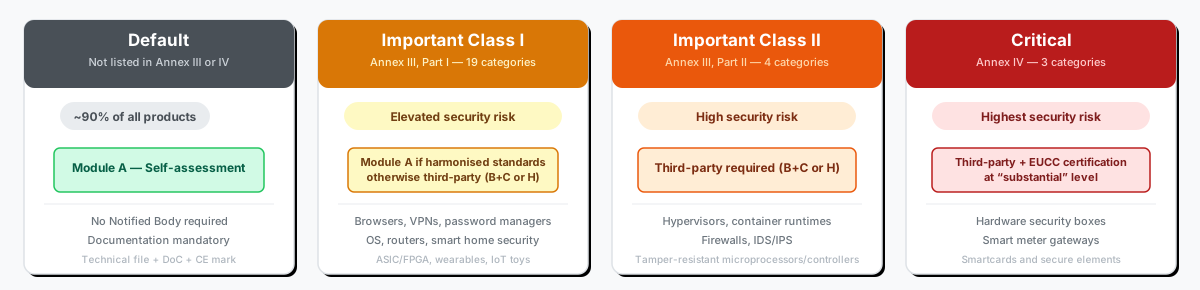
The CRA classifies products with digital elements into four tiers based on cybersecurity risk:
Default Products
The vast majority of products fall here. If your product isn't specifically listed in Annex III or IV, it's "Default."
Conformity assessment: Self-assessment (Module A) is sufficient.
Examples:
- Simple IoT sensors
- Basic consumer electronics
- Standard business software
- General-purpose applications
- Non-networked embedded devices
Important Class I (Annex III, Part I)
Products with elevated risk due to their function or user base.
Conformity assessment: Self-assessment allowed IF you fully apply relevant harmonized standards. Otherwise, third-party assessment required.
Full list from Annex III, Part I:
- Identity management systems and privileged access management software and hardware, including authentication and access control readers, including biometric readers
- Standalone and embedded browsers
- Password managers
- Software that searches for, removes, or quarantines malicious software
- Products with digital elements with the function of virtual private network (VPN)
- Network management systems
- Security information and event management (SIEM) systems
- Boot managers
- Public key infrastructure and digital certificate issuance software
- Physical and virtual network interfaces
- Operating systems
- Routers, modems intended for the connection to the internet, and switches
- Microprocessors with security-related functionalities
- Microcontrollers with security-related functionalities
- Application specific integrated circuits (ASIC) and field-programmable gate arrays (FPGA) with security-related functionalities
- Smart home general purpose virtual assistants
- Smart home products with security functionalities, including smart door locks, security cameras, baby monitoring systems and alarm systems
- Internet connected toys covered by Directive 2009/48/EC that have social interactive features (e.g. speaking or filming) or that have location tracking features
- Personal wearable products to be worn or placed on a human body that have a health monitoring (such as tracking) purpose and to which Regulation (EU) 2017/745 or (EU) No 2017/746 do not apply, or personal wearable products that are intended for the use by and for children
Important Class II (Annex III, Part II)
Higher-risk products requiring mandatory third-party assessment.
Conformity assessment: Third-party (Notified Body) assessment required. No self-assessment option.
Full list from Annex III, Part II:
- Hypervisors and container runtime systems that support virtualised execution of operating systems and similar environments
- Firewalls, intrusion detection and prevention systems
- Tamper-resistant microprocessors
- Tamper-resistant microcontrollers
Critical Products (Annex IV)
The highest-risk category. Hardware security modules and similar.
Conformity assessment: Third-party assessment PLUS European Union Cybersecurity Certification (EUCC) at "substantial" level or higher.
Full list from Annex IV:
- Hardware Devices with Security Boxes
- Smart meter gateways within smart metering systems as defined in Article 2, point (23) of Directive (EU) 2019/944 and other devices for advanced security purposes, including for secure cryptoprocessing
- Smartcards or similar devices, including secure elements
Decision Tree: Finding Your Category
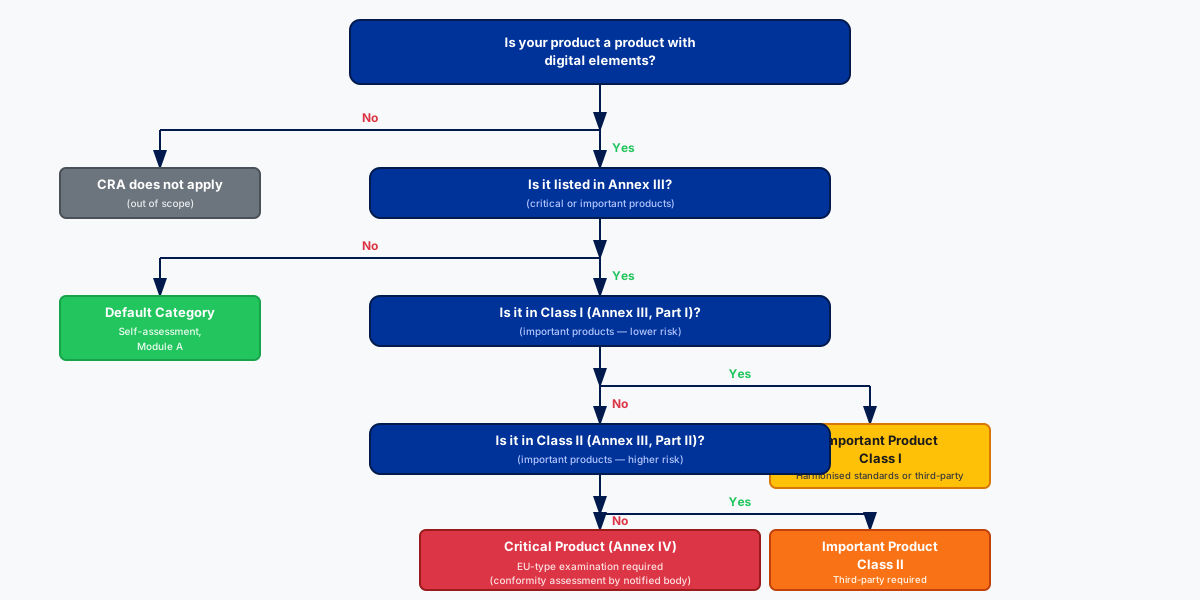
Use this process to classify your product:
START: Does your product have digital elements?
|
+- NO → Not in CRA scope. Stop here.
|
\- YES → Is it listed in Annex IV (Critical products)?
     |
     +- YES → CRITICAL
     |        Third-party + EUCC certification required
     |
     \- NO → Is it listed in Annex III, Part II (Important Class II)?
          |
          +- YES → IMPORTANT CLASS II
          |        Third-party assessment required
          |
          \- NO → Is it listed in Annex III, Part I (Important Class I)?
               |
               +- YES → IMPORTANT CLASS I
               |        Third-party OR self-assessment with standards
               |
               \- NO → DEFAULT
                        Self-assessment (Module A) permitted
Conformity Assessment Routes by Category
| Module | Available for | Notified Body |
|---|---|---|
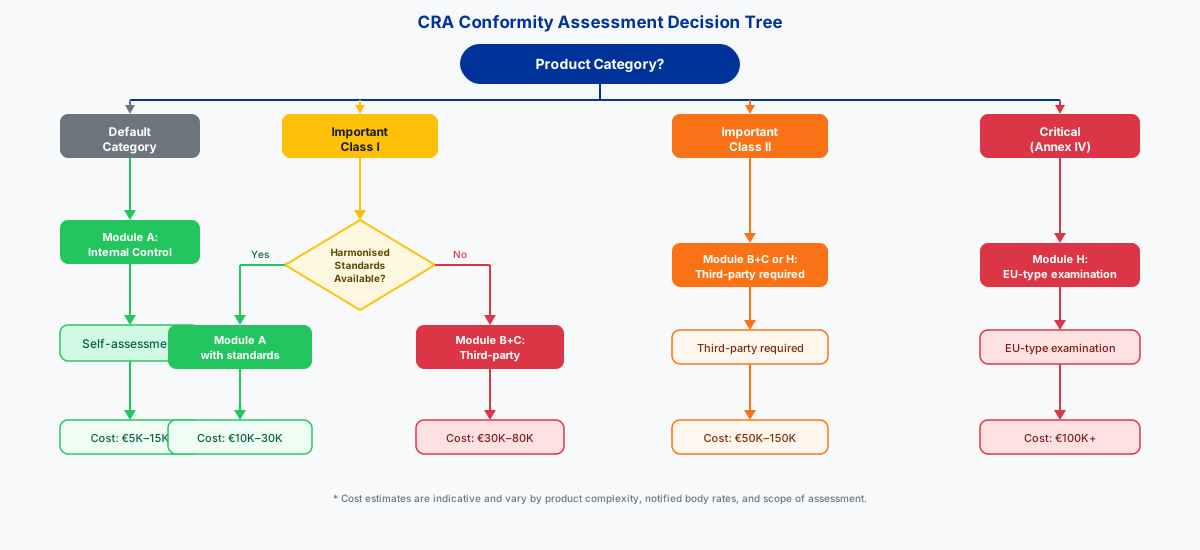
| A — Internal Production Control | Default; Class I with harmonized standards applied | Not required |
| B+C — EU-Type Examination + Production Control | Class I without standards; Class II; Critical | Required |
| H — Full Quality Assurance | Any category — alternative to B+C | Required |
| EUCC — EU Cybersecurity Certification | Critical (Annex IV) only, in addition to B+C or H | Required |
Module A is the full self-assessment cycle: technical file, EU Declaration of Conformity, CE marking. No external auditor involved.
Module B+C splits the work: a Notified Body examines a type specimen and issues a certificate (Module B); the manufacturer then ensures all production conforms to that type (Module C).
Module H replaces the product-by-product approach with an audit of the manufacturer's quality management system. Better suited when you have a large product portfolio.
EUCC sits on top of Module B+C or H for Critical products. Issued under the EU Cybersecurity Act at "substantial" assurance level or higher by an accredited conformity assessment body.
How Do You Classify a Product That Falls Into Multiple Categories?
Not every product is a clean fit. These are the most common edge cases:
Multi-Function Products
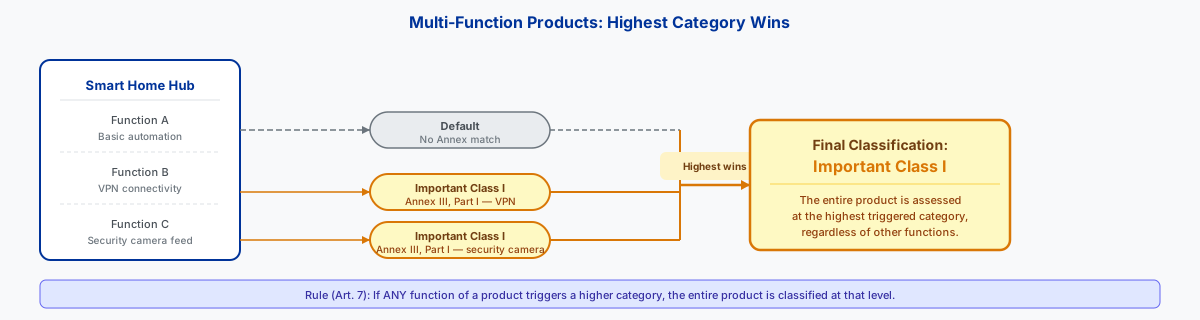
Rule: If ANY function triggers a higher category, the entire product is classified at that level.
Example: A smart home hub that includes:
- Basic automation control (Default)
- VPN functionality (Important Class I)
- Security camera integration (Important Class I)
Classification: Important Class I (highest triggered category)
Embedded Components
Rule: Consider whether security-relevant components trigger classification.
Example: A consumer device containing:
- General-purpose microcontroller → Default
- Microcontroller "with security-related functionalities" → Important Class I
Key question: Does the microcontroller perform security functions (encryption, authentication, secure boot)?
"Intended For" Considerations
Some Annex III items specify intended use or product context (e.g. items referencing "connected toys covered by Directive 2009/48/EC" or health monitoring wearables that reference Regulations 2017/745 and 2017/746).
If your product could be used in these contexts but isn't specifically intended for them, the classification may not apply. Document your intended use clearly.
Operating Systems
Operating systems are listed only in Annex III Part I (Important Class I). There is no operating system category in Class II:
| OS Type | Classification |
|---|---|
| Embedded OS (RTOS, firmware) | Default (usually) |
| General-purpose OS | Important Class I |
Example: A custom Linux distribution for embedded devices would typically be Important Class I. Ubuntu Server is Important Class I.
Software vs Hardware
Classification considers the product as placed on the market:
- Standalone software: Classified based on software function
- Hardware with embedded software: Classified based on combined functionality
- Software component sold separately: Classified independently
Industry-Specific Guidance
IoT Device Manufacturers
Most IoT devices are Default unless they:
- Include VPN functionality → Class I
- Are smart home security devices → Class I
- Are industrial IoT → Class I or II
- Include tamper-resistant security features → Class II
Software Companies
Most software is Default unless specifically listed:
- Browsers, password managers, anti-malware → Class I
- Network security tools (firewalls, IDS) → Class II
- Operating systems → Class I
Embedded Systems
Classification depends heavily on:
- Security functions of microcontrollers/processors
- Whether product is industrial/professional use
- Target deployment environment (critical infrastructure?)
Medical Devices
Medical devices are excluded from CRA scope (covered by MDR/IVDR). However, companion software or non-medical functions may still be in scope.
Finding a Notified Body
For products requiring third-party assessment:
- Check the NANDO database: EU's official list of Notified Bodies
- Look for CRA-specific designation: Bodies must be designated for CRA conformity assessment
- Consider capacity: Early CRA adoption means limited NB availability
- Geographic considerations: Working with an NB in your region may be easier
The CRA's Notified Body designation process is ongoing. Check the NANDO database directly for the current list of designated bodies.
Common Classification Mistakes
Important: Classification is based on product function, not market sector, company size, or product complexity. Always check Annex III and IV lists.
"Consumer product = Default"
Wrong. Classification is by function, not market.
A smart door lock sold to consumers is Important Class I because it's a "smart home product with security functionality," regardless of the consumer target market.
"We're B2B, so lower classification"
Wrong. B2B vs B2C doesn't affect classification.
Industrial IoT products for business customers may be Important Class I or II depending on their function.
"Our product is small/simple, so Default"
Maybe wrong. Size and complexity don't determine classification.
A tiny microcontroller with security functions may be Important Class I. A large, complex product without listed functions may be Default.
"We already have ISO 27001, so we're covered"
Wrong. ISO 27001 is for organizational information security, not product conformity assessment.
CRA requires product-specific conformity assessment regardless of organizational certifications.
Product Classification Checklist
PRODUCT CLASSIFICATION CHECKLIST

Product: _______________________________________
Date: _________________________________________

INITIAL SCOPE CHECK:
[ ] Product has digital elements (software and/or data connection)
[ ] Product will be placed on EU market
[ ] Product is not excluded (medical, automotive, aviation, military)

ANNEX IV CHECK (CRITICAL):
[ ] Not a hardware device with a security box
[ ] Not a smart meter gateway (as defined in Directive (EU) 2019/944 Art. 2(23)) or other device for advanced security purposes
[ ] Not a smartcard or similar device, including secure elements

If any above are YES → CRITICAL (stop here)

ANNEX III PART II CHECK (IMPORTANT CLASS II):
[ ] Not a hypervisor or container runtime system
[ ] Not a firewall, intrusion detection or prevention system
[ ] Not a tamper-resistant microprocessor
[ ] Not a tamper-resistant microcontroller

If any above are YES → IMPORTANT CLASS II (stop here)

ANNEX III PART I CHECK (IMPORTANT CLASS I):
[ ] Review full list of 19 categories
[ ] Consider multi-function implications
[ ] Check for security-related functionalities in components

If any category applies → IMPORTANT CLASS I (stop here)

DEFAULT:
[ ] Product not listed in any Annex
[ ] Classification: DEFAULT

CONFORMITY ASSESSMENT ROUTE:
[ ] Module A (self-assessment) - Default, Class I with standards
[ ] Module B+C (third-party) - Class I without standards, Class II
[ ] Module H (quality assurance) - Alternative to B+C
[ ] EUCC certification - Critical products only

DOCUMENTATION:
[ ] Classification rationale documented
[ ] Multi-function analysis completed
[ ] Intended use clearly defined
[ ] Notified Body identified (if required)

Classified by: _________________________________
Date: _________________________________________
Frequently Asked Questions
Does a smart home router fall under Important Class I or Default?
Important Class I. Routers "intended for the connection to the internet" are listed in Annex III Part I, item 12. Self-assessment is available if you fully apply a relevant harmonised standard. Without one, a Notified Body is required. See CRA conformity assessment routes.
Does the CRA apply to SaaS products with no physical hardware?
It depends on what the software does. SaaS that provides remote data processing integral to a product with digital elements is in scope under Article 3(1). A standalone web application with no associated hardware may also qualify depending on its function. If it does, classification uses the same Annex III and IV lists as any physical product.
If my product has both Default and Class I functions, which category applies?
The highest applicable category governs the whole product. If any single function matches an Annex III or IV listing, the entire product is assessed at that tier. A network switch that also includes a VPN concentrator is Important Class I for the full device, not just the VPN component.
Does ISO 27001 certification affect my CRA product classification?
No. Classification is determined by product function against Annex III and IV only. Organisational certifications play no role. ISO 27001 addresses company-level information security management. CRA requires per-product conformity assessment regardless of what the manufacturer holds. See CRA vs ISO 27001.
When does CRA product classification need to be determined?
Before placing the product on the EU market. Classification sets your conformity assessment route, which must be completed before you can affix the CE marking and issue the Declaration of Conformity. See the CRA implementation timeline for key dates.
Where do I find a Notified Body for CRA conformity assessment?
The NANDO database at nando.ec.europa.eu is the official EU registry of Notified Bodies. CRA-specific designations are still being published as the programme ramps up, so check directly for bodies listed under Regulation (EU) 2024/2847. For Important Class I products, a Notified Body is only required if you are not applying a relevant harmonised standard.
Next Steps
Managing CRA compliance across multiple products? CRA Evidence tracks classification, conformity routes, and documentation in one place.
Once you know your classification, the next step is your conformity assessment route. Check the CRA implementation timeline for key deadlines. Note that all categories, regardless of tier, require an SBOM. See the SBOM requirements guide.
This article is for informational purposes only and does not constitute legal advice. For specific compliance guidance, consult with qualified legal counsel familiar with EU product regulations.
Related Articles
ECSMAF v3.0 Explained: How ENISA Maps the EU Cybersecurity Market
Does the CRA apply to your product?
Answer 6 simple questions to find out if your product falls under the EU Cyber Resilience Act scope. Get your result in under 2 minutes.
Ready to achieve CRA compliance?
Start managing your SBOMs and compliance documentation with CRA Evidence.