European Cybersecurity Certification Conference 2026: 29 EUCC certs, enough CABs?
ENISA reported 29 EUCC certificates and 28 accredited CABs after EUCC's first year. What that capacity means for CRA conformity assessment.

In this article
On 15 April 2026 ENISA held its European Cybersecurity Certification Conference in Ayia Napa, Cyprus, co-organised with the Cyprus Presidency and the European Commission. One day, hybrid format, six tracks: EUCC in year one of operation, the proposed CSA2 and its revised European Cybersecurity Certification Framework (ECCF), certification's role under the CRA, a new NIS2 route through the cyber posture scheme, the EU Digital Identity Wallet scheme now in public consultation, and the EU Managed Security Services (MSS) scheme at draft v4.
The audience concern that dominated the day, by vote count on the online Q&A, was not any single scheme. It was whether certification results can or should be used to infer NIS2 compliance, given that NIS2 supervision sits with different authorities. Five of the seven top-voted questions circled that one tension. We address it in its own section below.
What follows is a structured readout of what was actually said, with speaker attribution kept to where the programme and transcripts agree.
Update, 17 October 2026: This post reports the conference of 15 April 2026, and its figures and plans are the ones stated that day. Since then, the EUDI Wallet public review closed on 30 April 2026, and ENISA lists no later step on its certification portal. ENISA ran the public consultation on the Managed Security Services scheme from 24 July to 13 September 2026. The Commission's implementation page (updated 27 July 2026) lists a delegated act on the EUCC and CRA presumption of conformity as planned for Q4 2026.
Certification is a proxy for absent trust.
Summary
- CSA2 is a proposed regulation that revises the European Cybersecurity Certification Framework and amends the NIS2 directive. Draft length: 271 pages, per panellists.
- ECCF replaces the current certification framework with model provisions, formal maintenance mechanisms, and a 12-month default timeline for candidate scheme development.
- EUCC live counts (Juhan Lepassaar, Executive Director, ENISA): 29 certificates issued, 28 conformity assessment bodies across the EU, Europe accounts for more than 60% of ~350 global Common Criteria certificates issued yearly, and all EU CC certificates are at CC-1 as of February 2026.
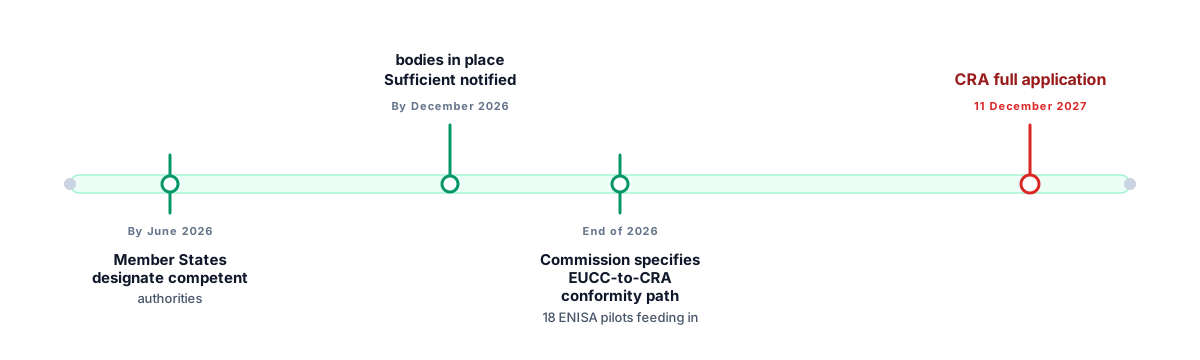
- CRA conformity infrastructure is this year's biggest CRA implementation milestone, per Maika Fohrenbach (DG CONNECT): Member States must designate competent authorities by June 2026, and sufficient notified bodies should be in place by December 2026, one year ahead of CRA's full application.
- EUDI Wallet scheme public consultation launched 3 April 2026; next anchor dates run from AHWG draft validation on 16–17 April 2026 through ECCG finalisation in September–October 2026.
- EU MSS scheme is at draft v4, sent to the ad hoc working group on 9 April 2026; draft v3 (sent 20 March 2026) received 250 comments across nine themes. Public consultation was planned for early July 2026 and ran from 24 July to 13 September 2026.
- Industry pushback on proliferation was sharp. Steffen Zimmermann (VDMA) put numbers on it: around 80% of VDMA members are SMEs, of whom roughly 90% are affected by NIS2 and the CRA.
- Audience priority of the day was not any single scheme. It was the tension between using certification results to infer NIS2 compliance and the fact that NIS2 supervision is mandatory and sits with different authorities (five of seven top-voted questions).
Source: Juhan Lepassaar, Executive Director, ENISA, opening keynote.
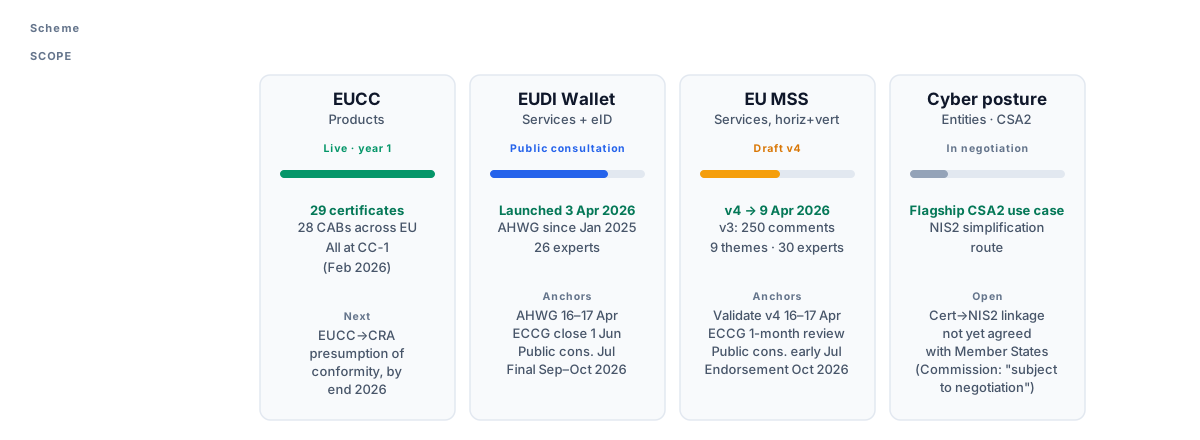
CSA2 and the new ECCF
Maika Fohrenbach (DG CONNECT) presented the Commission's proposal. It is structured around four pillars:
- A harmonised ICT supply chain risk management framework, at EU level for the first time.
- A revised European Cybersecurity Certification Framework (ECCF).
- NIS2 simplification measures, built around a new cyber posture scheme (its own section below).
- Reinforcement of ENISA's mandate (Member State support, situational awareness, standardisation leadership, skills attestation).
Three ECCF changes matter for manufacturers:
Certification is technical assurance, not a broader foreign-interference instrument. High-risk suppliers and high-risk ICT assets are explicitly excluded and handled through the supply chain framework. CABs cannot stem from designated countries of concern.
Certification now covers entities, not only products, services and processes. The cyber posture scheme is the flagship use case. Fohrenbach called this "probably one of the biggest impacts for businesses".
CSA2 introduces template provisions that scheme developers can adapt, the way the CRA uses the New Legislative Framework. Fohrenbach called it "the NLF for certification".
On maintenance and stakeholder tooling, CSA2 formally recognises ENISA as scheme manager, with a dedicated ECCG subgroup for each scheme. It replaces the current Stakeholder Cybersecurity Certification Group (SCCG) and Union Rolling Work Programme with a European Cybersecurity Certification Assembly plus Commission and ENISA information portals. The legal basis for ENISA-authored technical specifications, building on the EUCC "state of the art" documents, is written into the proposal.
Panel reactions were candid. Helge Kreutzmann (BSI) named two gaps in the draft. First, CSA2 keeps the old authorisation plus notification split instead of going fully to the New Legislative Framework's notification mechanism. Second, scope was not extended boldly enough: the draft certifies services but not providers, while several Member States already certify providers and key personnel, and the Cyber Solidarity Act requests it. Kreutzmann: "We think this should carry over on the European level, that we can actually certify the providers."
Suzana Pavlidou (NCCA Cyprus) and Apostolos Malatras (Head of Unit for Cybersecurity Certification, ENISA) joined Philippe Blot as moderator. Goran Gotov (Zscaler) raised a structural concern from the floor: the Assembly meets once a year and ad hoc groups are scheme-specific, which makes macro-level industry input thinner than before. Richard Skalt (TIC Council; cybersecurity advocacy manager at TÜV SÜD) pressed for a 12-month deadline commitment on ENISA scheme development, and asked whether CSA2 will integrate ISO/IEC 27001 and Belgium's "Cyber Fundamentals" scheme into the NIS2 simplification route. No firm commitment on that integration was given on stage.
Cyber posture and NIS2: what the audience actually asked
The Q&A feed made the audience priority unambiguous. The seven highest-voted questions of the day (14 to 19 votes each) were not about EUCC throughput or CAB capacity. They were about the same structural worry, phrased seven ways: can certification results legitimately be used to infer NIS2 compliance, when NIS2 supervision is mandatory and done by different authorities?
Fohrenbach's answer ran across her presentation and the Q&A. Three pieces are worth separating:
For the EUCC, Fohrenbach said, presumption of conformity with the CRA is being worked out after the fact. For future schemes, including the cyber posture scheme, alignment with existing legislation (NIS2 in this case) is to be built in from the request stage. Her framing: "In the future, this is the work that would be done from the very beginning of the request stage of a scheme, that you think about how this scheme can be used and will enable also compliance with existing legislation."
"The cyber posture scheme will also need to reflect the specificity of the fact that NIS2 is a directive, and there will be also important discussions on the interplay with existing national certification schemes that exist today on the market." The Commission's lever for that: an implementing regulation with maximum harmonisation, sitting on top of the scheme, so the baseline requirements do not fragment across 27 national transpositions.
"Obviously the proposal of the Commission is also subject to negotiation, and of course the whole interplay between how you can use the future cyber posture scheme to demonstrate conformity with NIS2 will be an important point of discussion with the Member States." In plain terms: the policy intent is on the record, the linkage is not.
On the two audience questions that did not get a stage answer, we are not filling gaps. We flag them:
| Audience question (top-voted on the day) | On-stage answer | Status |
|---|---|---|
| How will the certification framework ensure alignment with NIS2? | Cyber posture scheme, designed ex-ante to enable NIS2 compliance | Answered |
| Has the Commission agreed the cert-to-NIS2 linkage with Member States? | "Subject to negotiation" | Partial |
| Could inconsistent outcomes arise between cert results and NIS2 supervision (different authorities)? | Acknowledged: NIS2 is a directive, interplay with national schemes needs work | Partial |
| How to interpret ECCF use in a NIS2 context, since cert schemes and regulatory frameworks serve different purposes? | Ex-ante design principle for new schemes; EUCC handled ex-post | Partial |
| Will CSA2 take into account existing implementing acts (MSS, cloud) and standards like ISO/IEC 27001 and Belgium's Cyber Fundamentals? | No firm commitment. BSI supported the direction; Fohrenbach pointed to model provisions | Partial |
| Would a formal statement confirming satisfactory NIS2 supervision be a sounder basis than inferring compliance from certification results? | Not addressed on stage | Unanswered |
| How will cyber posture schemes handle entities operating across multiple Member States with different national requirements? | Not addressed on stage (closest adjacent comment: "interplay with existing national schemes") | Unanswered |
For readers planning around NIS2, the honest read is this. The cyber posture scheme is the Commission's preferred route. The legal mechanics that would make that route robust (the implementing regulation with maximum harmonisation, Member State agreement on the linkage) are live negotiation items. If you are building a compliance strategy today, do not treat "certify under cyber posture and NIS2 is handled" as a settled fact for your jurisdiction. Watch the trilogue.
Where certification meets the CRA
Fohrenbach's CRA tie-in was the clearest manufacturer signal of the day. Headline for 2026: build the conformity assessment infrastructure. Harmonised standards will land later, and unevenly.
The CRA covers software products, hardware products, and components placed separately on the market. The distribution Fohrenbach stated:
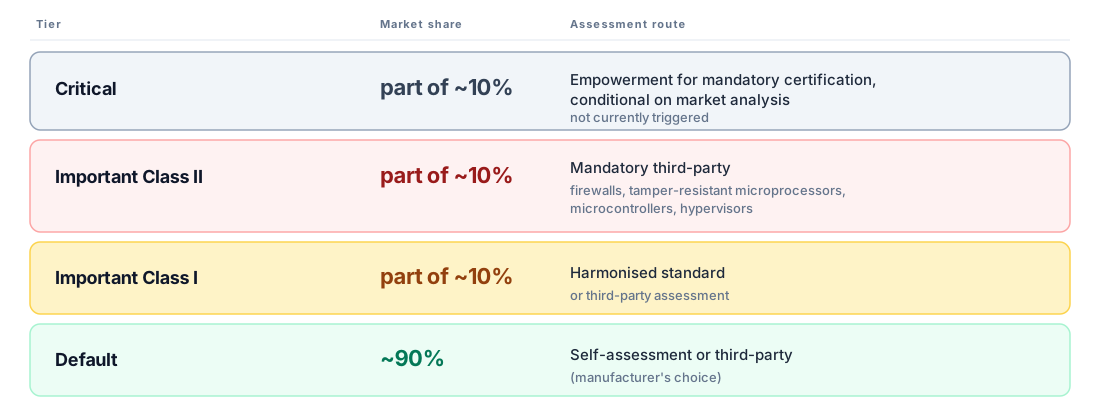
Under CRA Annex VIII, the available New Legislative Framework modules are Module B + C (EU type examination) and Module H (quality system certification). The Commission's stated intention is to specify, before the end of 2026, how the EUCC can be used to demonstrate conformity with the CRA (its implementation page, updated 27 July 2026, lists a planned delegated act for Q4 2026). ENISA is running 18 pilots on EUCC-to-CRA presumption of conformity, with a workshop in Athens planned.
The run-up to full CRA application in one view:
Will CSA2 be adopted before CRA full application? Currently in trilogue.
The harmonisation work happens in an informal Commission-level working group of notifying authorities, with one of the main open questions being how to notify when harmonised standards are not yet available. Fohrenbach flagged CENELEC as the driver of the harmonised standards work. The working hypothesis across Member States: leverage CABs already accredited under the Radio Equipment Directive Delegated Act (RED DA) and the EUCC ecosystem, and fast-track them for CRA notification.
For the current state of module selection while CSA schemes are still pending, see our conformity assessment decision guide.
The CAB capacity gap
The CAB capacity panel was the most operationally loaded session of the day. It was moderated by Eric Vetillard; on the panel: Christin Hartung-Kümmerling (BSI, online), Xenia Kyriakidou (head of NCCA Cyprus, Cyprus's notifying and market surveillance authority for the CRA, and vice-chair of the ADCO CRA committee), Richard Skalt (TIC Council / TÜV SÜD), and Nikolaos Soumelidis (Q-CERT).
A few facts from the panel worth pulling forward:
- Two-thirds of European countries do not yet have an eIDAS national accreditation body, per Soumelidis. Greece itself does not have one.
- BSI is preparing Module H notification as the most scalable route for CRA, per Hartung-Kümmerling. BSI is not prioritising Module B for CRA; she acknowledged that other Member States are taking the Module B route but did not name them.
- Cyprus, Germany, and most other Member States will rely on their national accreditation bodies for CRA accreditation. Fast-tracking via RED DA or EUCC accreditation is on the table.
- TIC Council internal survey (Skalt): two-thirds of TIC Council members plan to have more than 50 dedicated cybersecurity experts by end of 2026, and 40% of members are already notified for EUCC.
- ADCO CRA is the Administrative Cooperation Group of Member State market surveillance authorities for the CRA; Kyriakidou is its vice-chair.
Stefan Zimmermann (VDMA) asked Hartung-Kümmerling from the floor which Member States are preparing Module B notification. She declined to name them on stage. The question is live because it affects whether a manufacturer who wants an EU type examination route has a notified body available in their home market on 11 December 2027.
From a manufacturer's perspective, three things follow. First, if your product category pushes you into third-party assessment, check your home Member State's plan now. "Sufficient notified bodies by December 2026" is a policy aspiration, not a guarantee by jurisdiction. Second, the RED DA / EUCC CAB fast-track is the most plausible capacity expansion path, but it means your likely CAB pool is shaped by which bodies already serve radio equipment or Common Criteria markets. Third, Module H (quality system) is scaling faster than Module B (type examination) in at least one major Member State, which has implications for how you prepare evidence.
Steffen Zimmermann's (VDMA) morning session sharpened the industry view. Around 80% of VDMA members are SMEs under 250 employees, and roughly 90% of those are affected by NIS2 and the CRA. His five-part critique of certification was blunt:
- Not invented here. Existing IEC 62443, ISO/IEC 27001 and TISAX get dismissed in favour of EU-native schemes.
- Not good enough. The same IEC 62443 is then deemed insufficient once the CRA enters the picture.
- Untrusted certificate. Proprietary methodology drives stakeholders to demand new schemes with the same transparency flaw.
- Let's create market demand. Voluntary schemes with poor uptake get mandated via public procurement rather than rethought.
- Illusion of compliance. The certificate stays valid while the security degrades.
Take ISO 27001. If you have a process that says you shall document whether you've patched your service, and months after months you correctly document that you have not patched, then you are in compliance. Your process works. Your security is terrible. And the certificate becomes just a rubber stamp.
On harmonised standards under the CRA, his quotable line: "Harmonised standards do not cover all functionalities. They are developed to address the core functionality listed in the annexes. So a product may be in conformance for the core functionality, but the CRA demands conformity for the entire product."
EUDI Wallet certification
Evgenia Nikolouzou (ENISA) walked through the EUDI Wallet scheme's journey. The Commission request arrived in May 2024; a call for expressions of interest followed in October 2024 with 26 experts selected for the ad hoc working group; the AHWG kicked off in January 2025 and ran 7 plenary meetings and 4 thematic groups through February 2026; the scheme was submitted for review in April 2026 and public consultation opened on 3 April 2026.
The scheme covers the wallet plus the underlying eID scheme, and must cover products, services and processes because of how eIDAS is structured. Evaluation is two-stage: stage 1 is architecture and dependencies review, stage 2 is testing and vulnerability analysis, followed by certificate issuance and surveillance. Two levels of assurance are used: the tamper-resistant hardware layer is handled by the EUCC at AVA_VAN.4 / .5, and the application layer is handled by national schemes at AVA_VAN.3.
The timeplan, from the slide Nikolouzou presented on 15 April 2026, anchored on these planned milestones: AHWG validation of draft v0.4 on 16–17 April 2026; ECCG comments period closes 1 June 2026; public consultation starts at the beginning of July 2026; ECCG finalisation in September–October 2026. For a detailed analysis of what the wallet scheme requires from applicants and what that signals for future CRA-adjacent schemes, see our EUDI Wallet scheme breakdown.
Managed Security Services scheme
Vicente Gonzalez Pedros (ENISA) opened the afternoon session on the EU MSS scheme, followed by a panel moderated by Georgia Bafoutsou (ENISA) with Paloma Llaneza (Digital Trust Scheme Manager, CerteIDAS), Adrian Pauna (Oracle), Marios Ioannou (Columbia Group), Oscar Boizard (ANSSI), and Pablo Fernandez (Security Operations Centers Manager, CCN-CNI).
The Commission request reached ENISA at the end of April 2025. The original request covered the incident management life cycle vertical; ENISA split it into service profiles and chose incident response as the first profile to build. Under the Cyber Solidarity Act, once a European scheme covers a service contracted via the Act, providers must be certified two years after the scheme is in place.
The scheme architecture has two layers:
- A horizontal layer of common baseline requirements, standards-agnostic and service-agnostic, applicable to all MSS.
- A vertical layer of service-specific technical requirements (lifecycle management, expertise, incident-response scenarios, stakeholder collaboration, resource requirements).
Two points from Gonzalez Pedros are worth pulling forward. The horizontal layer is never certified on its own: the certificate is always for the service, never for the provider. And the horizontal layer aligns with NIS2 but does not certify NIS2 compliance. NIS2 coverage belongs to the cyber posture scheme, not MSS.
On the AHWG: more than 200 proposals came in via the open call. The incident response working group was formed with 30 experts, and a reserve list of 70 more was kept for future service profiles. The AHWG was officially appointed on 29 September 2025.
Draft progression (from the AHWG slide):
- Main Scheme Draft v3 sent to AHWG on 20 March 2026.
- 250 comments received, grouped into nine themes: relationship with NIS2, assurance levels for multiple profiles, evaluation standards and methodologies, cross-border oversight, terminology alignment, certification scope (client-specific vs general), evaluation repetition costs, NCCA and CAB dialogues, and confidentiality in certification reports.
- Main Scheme Draft v4 sent to AHWG on 9 April 2026.
One structural clarification from Gonzalez Pedros: the MSS scheme has no ITSEFs (unlike the EUCC). CAB and CB will be reconciled to a single term in the next draft. CAB accreditation is against ISO/IEC 17065, and the scheme builds on the same evaluation methodology ENISA is using for the European Wallet.
The scheme timeline he set out: validate draft v4 on 16–17 April 2026; first draft to ECCG for comments with one month for Member State review; address comments in about two weeks; public consultation from the beginning of July 2026 for 1.5 months; meet mid-September 2026 to address consultation comments; scheme endorsement in ECCG by October 2026.
What the panellists contributed
Paloma Llaneza (CerteIDAS) argued the core case for an EU-level scheme: without one, providers certify in 27 Member States separately, and only large firms can afford that. Her reference point was eIDAS-2, where one regulation plus an implementing act replaced 27 national standards with a single European standard. Llaneza is the editor of ETSI EN 319 401 (Policy and security requirements for Trust Service Providers), which she positioned as the working proportionality model: the horizontal layer is a one-time baseline, the verticals stack modularly on top.
Adrian Pauna (Oracle) made the multinational case: an EU scheme standardises compliance across jurisdictions, and penetration testing methodologies need clear definition inside the scheme. He noted a structural issue specific to pen testing: today it is certified at the person level (OSCP, OSCE), which makes service-level certification structurally difficult until the market shifts. His recommendation for next verticals: detection first, then pen testing.
Marios Ioannou (Columbia Group, Cyprus) framed the EU credential as a door-opener: recognition across the territory, and participation in the EU Cybersecurity Reserve. On cross-border incidents, he pointed out that a Spain to Cyprus to Malta response is far easier when all parties share the same baseline capabilities.
Oscar Boizard (ANSSI) drew the sharpest line of the session, on certification vs qualification:
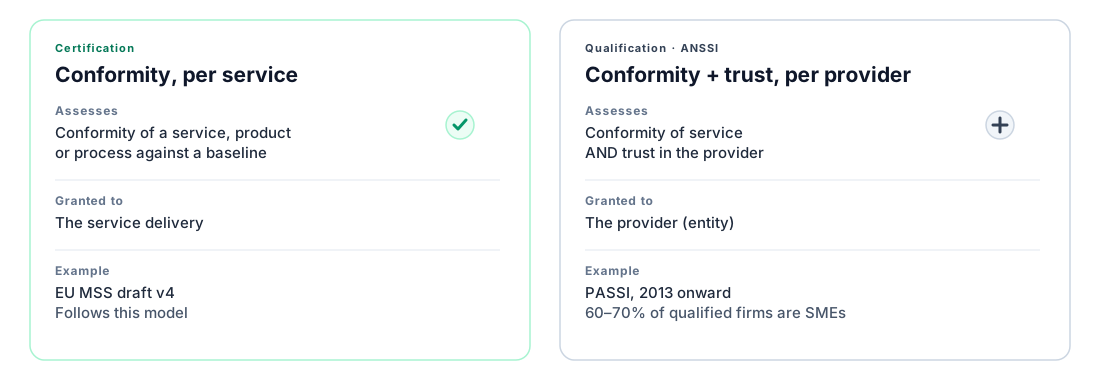
Kreutzmann (BSI) argued that CSA2 should enable provider-level qualification at EU level, beyond the current service-level certification.
France runs four ANSSI qualification schemes aligned with EU MSS categories (consulting, audit, detection, response), plus PAMS for administration. PASSI is the oldest and has the largest qualified-provider base. Introducing a substantial level materially changed the supplier mix: SMEs with six to seven competent staff made it in. Boizard's recommendation for the next vertical: auditing, as a quick win, because the standards already exist.
Pablo Fernandez (CCN-CNI) brought hard numbers from the Spanish approach. The Spanish MSS scheme started approximately four years ago, built on the ENS (Esquema Nacional de Seguridad), which itself has roughly 16 years of history. The MSS model is Guía CCN-STIC 896 layered on top of ENS, aligned with NIS2, the Cyber Solidarity Act amendments, and the incoming CSA2 and EU MSS. The CCN slide published figures: 3,578 certified entities under ENS, 25 MSS certified services delivered by 5 MSSPs, and 304 integrated SOCs in the national network of SOCs. Fernandez noted that CCN-STIC 896 will be available in English "in a couple of weeks", which is directly actionable for readers outside Spain.
Where the panellists landed on which MSS vertical should be built next:
| Panellist | Suggested next vertical |
|---|---|
| Llaneza · CerteIDAS | Detection |
| Pauna · Oracle | Detection, then pen testing |
| Ioannou · Columbia Group | Detection and recovery, then pen testing |
| Boizard · ANSSI | Auditing (quick-win, standards already exist) |
| Fernandez · CCN-CNI | Detection and recovery, then pen testing |
A useful detail from the floor: an audience question raised sovereignty as a factor (MSS providers that are national sovereign entities vs multinationals). Llaneza's answer was that EU-level regulation is needed to replace 27 national schemes, following the eIDAS-2 precedent. Ioannou's answer was that a shared baseline across Member States is what lets companies actually work together in a cross-border incident.
What this means for manufacturers shipping under CRA
The CRA milestone to focus on between now and 11 December 2027 is conformity assessment capacity, not harmonised standards. Harmonised standards will land late and unevenly. Competent-authority designation is a June 2026 deadline. A sufficient number of notified bodies by 11 December 2026 is a best-efforts duty on Member States under Article 35(2). If your product sits in Important Class II, your CAB pool is heavily shaped by which bodies are already notified for EUCC or accredited under the RED DA.
For Default and Important Class I manufacturers, the practical implication is that module choice matters more than usual this year. Module H (quality system) has clearer scaling signals from at least one major Member State; Module B (type examination) availability is uneven and not publicly mapped. If you can legitimately qualify under harmonised standards when they are available, that route removes a dependency on CAB supply.
The EUCC-to-CRA presumption of conformity via Delegated Act is not yet walkable, but it is the most specific piece of infrastructure under construction. The 18 pilots and the end-of-2026 aim the Commission signalled for specifying how the EUCC supports CRA conformity are what to track to the end of 2026. Treat that as a target, not a commitment: no act is adopted, and the date can move.
The MSS scheme is not directly a CRA product concern. It matters because it is the second CSA scheme in active drafting, after the EUDI Wallet, and it will ship ahead of the first CRA-specific scheme. The methodology choices ENISA locks in here (ISO/IEC 17065 CAB accreditation, the Wallet-aligned evaluation methodology) will carry into CRA-adjacent schemes later.
Frequently Asked Questions
What is CSA2, and is it a replacement for the current Cybersecurity Act?
CSA2 is a Commission proposal for a new regulation that revises the European Cybersecurity Certification Framework (ECCF) and amends the NIS2 directive. It is not a recast of the 2019 Cybersecurity Act. The proposal's four pillars are a harmonised ICT supply chain risk management framework, the revised ECCF, NIS2 simplification measures including a cyber posture scheme, and reinforcement of ENISA's mandate. Panel discussion at the conference put the draft length at 271 pages. For background on how CSA2 intersects with supply chain obligations, see our post on Cybersecurity Act 2 and supply chain certification.
Will there be a CSA scheme that covers CRA products by the time CRA fully applies?
Not on the current trajectory. The first two CSA schemes being finalised are the EUDI Wallet scheme (in public review on the day, with ECCG adoption then targeted for October 2026) and the EU MSS scheme (at draft v4 on the day, with endorsement then targeted for October 2026). Neither had been adopted when the conference took place. Neither covers CRA product categories. Fohrenbach stated the Commission intends to specify, before the end of 2026, how the EUCC can be used to demonstrate conformity with the CRA, which would give Critical and some Important products a path. The Commission's implementation page (updated 27 July 2026) lists a planned delegated act for Q4 2026. For the current module options while that work completes, see the conformity assessment decision guide.
What is the cyber posture scheme, and does certifying under it prove NIS2 compliance?
The cyber posture scheme is a proposed CSA2 scheme designed to let entities demonstrate NIS2 compliance through certification. It is the flagship use case for the extension of CSA2 scope from products, services and processes to entities. The important caveat: the Commission has not yet agreed the cert-to-NIS2 linkage with Member States. Fohrenbach described it as "subject to negotiation", and flagged that NIS2 is a directive, so the scheme must sit alongside national transpositions. The proposed lever is an implementing regulation with maximum harmonisation on the baseline requirements. Two related audience questions at the conference, on whether a formal NIS2 supervision statement would be a sounder basis, and on how the scheme handles entities operating in several Member States, did not receive a stage answer. Treat the route as policy direction, not settled fact.
What is the CAB capacity gap, and should I plan around it?
Article 35(2) says Member States shall strive to ensure a sufficient number of notified bodies by 11 December 2026. That is a best-efforts duty on Member States, not a guarantee by Member State. BSI confirmed on the panel that it is prioritising Module H (quality system) over Module B (type examination) for CRA, and several other Member States are in the Module B camp without publicly naming themselves. Greece does not currently have an eIDAS national accreditation body, and Soumelidis stated that around two-thirds of European countries are in the same position. If your product requires third-party assessment, check your home Member State's plan now and treat geography as a scheduling variable. For how importers should read CAB availability into supplier contracts, see the importer verification guide.
How does the EUDI Wallet scheme relate to the CRA, if at all?
The EUDI Wallet scheme is the first CSA scheme for ICT services, not products. It does not apply directly to CRA products. But it is the clearest preview of how ENISA will handle SBOMs, supply chain evidence, ISO 27001 treatment, and continuous surveillance in any future CRA-adjacent CSA scheme. For mobile wallet applications placed on the market commercially, CRA and the wallet scheme can both apply in parallel. For a full breakdown, see our post on the EUDI Wallet scheme and CRA conformity.
What is the difference between certification and qualification that ANSSI raised?
Certification assesses conformity of a service (or product, or process) against a defined baseline. Qualification, as ANSSI applies it, additionally assesses the trust that can be placed in the service provider as an entity, and it is granted to the provider, not to a specific service delivery. France has run its qualification schemes since 2013 (PASSI), and introducing substantial-level qualification brought SMEs into the qualified-provider pool; 60 to 70% of PASSI-qualified companies are now SMEs. The distinction matters for the EU MSS scheme because the scheme as drafted certifies services, not providers, which is one of the nine comment themes raised against draft v3.
What is in Guía CCN-STIC 896 and why does it matter outside Spain?
CCN-STIC 896 is the Spanish MSS model, layered on top of the ENS (Esquema Nacional de Seguridad). The CCN reports 3,578 certified entities under ENS, 25 MSS certified services delivered by 5 MSSPs, and 304 integrated SOCs in the national network of SOCs. Pablo Fernandez (CCN-CNI) stated at the conference that STIC 896 will be available in English in a couple of weeks. For non-Spanish MSSPs, it is one of the few public, working references that uses the horizontal plus vertical layer architecture the EU MSS scheme is building on.
What should I do about the 11 December 2026 notified-body capacity target?
Map three things. First, your product's position in the CRA tier (Default, Important Class I, Important Class II, Critical), because that determines whether third-party assessment is optional, conditional, or mandatory. Second, the notified-body landscape in your home Member State, with a fallback plan if no NB is notified for your module by late 2026. Third, your evidence readiness (SBOM, technical file, CVD policy, vulnerability handling), because those artefacts are the input to any module. For a concrete artefact checklist, see our technical file guide and the SBOM generation guide.
Related Articles
Does the CRA apply to your product?
Answer up to 11 simple questions to find out if your product falls under the EU Cyber Resilience Act scope. Get your result in under 2 minutes.
Ready to achieve CRA compliance?
Start managing your SBOMs and compliance documentation with CRA Evidence.