CRA vs ISO 27001: The Compliance Gaps Your ISMS Won't Cover
Does ISO 27001 cover the Cyber Resilience Act? Not fully. Maps the exact gaps, what your ISMS transfers, and what you still need before the 2027 deadline.

In this article
- Summary
- What Does ISO 27001 Cover vs What the CRA Requires?
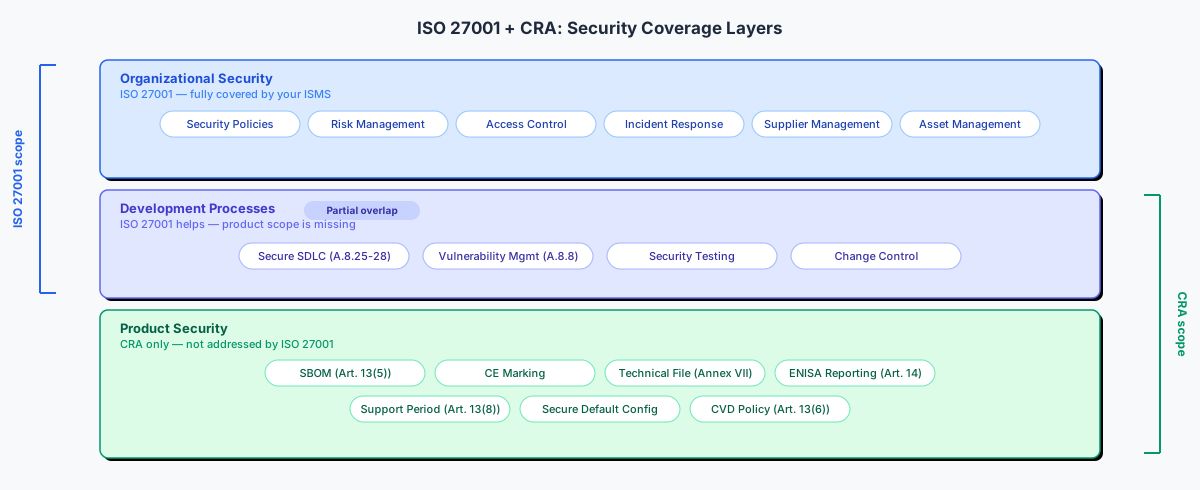
- Where ISO 27001 Helps CRA and Where It Falls Short
- How to Leverage ISO 27001 for CRA
- ISO 27001 Annex A Controls and CRA
- Does ISO 27001 Certification Count Toward CRA Conformity Assessment?
- Three Common ISO 27001 + CRA Scenarios
- How to Integrate CRA Into Your Existing ISMS
- ISO 27001 to CRA Integration Workstreams
- Frequently Asked Questions
- Next Steps
If your company is ISO 27001 certified, you might assume you are well-positioned for the Cyber Resilience Act (CRA). You are not. At least not without significant additional work.
ISO 27001 protects your organization's information assets. The Cyber Resilience Act (Regulation (EU) 2024/2847) requires that every product with digital elements you place on the EU market is secure by design, ships with a software bill of materials (SBOM), and is supported with security updates for its expected lifetime. These are product-level obligations, not organizational ones. Non-compliance carries fines up to EUR 15 million or 2.5% of global annual turnover (Art. 64). See the CRA penalties guide.
Article 14 reporting obligations have applied since September 11, 2026. Full compliance is required by December 11, 2027. See the full CRA implementation timeline.
This guide on ISO 27001 vs CRA maps exactly where your ISMS helps, where it falls short, and what you need to add.
Summary
- ISO 27001 = organizational/enterprise security management
- CRA = product cybersecurity requirements (Annex I, Regulation (EU) 2024/2847)
- ISO 27001 does NOT equal CRA compliance
- ISO 27001 provides a foundation for secure development processes
- CRA requires product-specific evidence: SBOM, vulnerability handling, CE marking
- Both together = strong overall security posture
Source: Regulation (EU) 2024/2847, Articles 13, 14 and 64.
What Does ISO 27001 Cover vs What the CRA Requires?
What ISO 27001 Covers
ISO 27001 is an information security management system (ISMS) standard for organization-level controls.
Organization-level controls- Information security policies
- Asset management
- Access control to systems and data
- Cryptography use
- Physical, operations, and communications security
- Supplier relationships
- Incident management
- Business continuity
- Compliance management
Focus: protecting your organization's information assets.
What CRA Covers
CRA is a product regulation covering cybersecurity requirements for products with digital elements (Annex I).
Product-level requirements- Security-by-design in products
- No known exploitable vulnerabilities
- Secure default configuration
- Protection from unauthorized access in the product
- Product data protection and update capability
- Vulnerability handling and ENISA reporting
- SBOM for product components (Annex I, Part II(1))
- Coordinated vulnerability disclosure policy (Annex I, Part II(5))
- Public vulnerability contact (Annex I, Part II(6))
- CE marking and conformity assessment
Focus: ensuring products you sell are secure.
The CRA classifies products into categories: default, Important Class I, Important Class II, and Critical (Annex III and IV). Each category carries different conformity assessment requirements. An Important Class II product requires third-party assessment (a notified body, or a European cybersecurity certification scheme at assurance level 'substantial' where one is available), regardless of your ISO 27001 certification status. See the CRA product classification guide.
The Fundamental Difference
ISO 27001 vs CRA SCOPE

ISO 27001:
"How does your ORGANIZATION manage security?"
+---------------------------------------------+
| Your Company                                |
| +---------+ +---------+ +---------+         |
| | Systems | | Data    | | People  |         |
| \---------+ \---------+ \---------+         |
| +---------+ +---------+ +---------+         |
| | Process | | Network | | Facilit |         |
| \---------+ \---------+ \---------+         |
\---------------------------------------------+

CRA:
"How secure are the PRODUCTS you sell?"
+---------------------------------------------+
| Your Products (sold to customers)           |
| +---------+ +---------+ +---------+         |
| |Product A| |Product B| |Product C|         |
| \---------+ \---------+ \---------+         |
|                                             |
| Each product must meet CRA requirements     |
\---------------------------------------------+
Where ISO 27001 Helps CRA and Where It Falls Short
Where ISO 27001 Helps CRA
| CRA Requirement | ISO 27001 Support | How It Helps |
|---|---|---|
| Secure development | A.8.25-28 (Secure development) | Process foundation |
| Vulnerability handling | A.8.8 (Technical vulnerabilities) | Organizational process |
| Incident response | A.5.24-26 (Incident management) | Response capability |
| Supplier management | A.5.19-22 (Supplier relationships) | Supply chain security |
| Access control | A.5.15-18, A.8.2-5 | Development environment security |
| Cryptography | A.8.24 (Cryptography) | Crypto policy foundation |
| Documentation | A.5.1 (Policies), 7.5 (Documented info) | Documentation culture |
| Risk assessment | 6.1 (Risk assessment) | Risk methodology |
Where ISO 27001 Falls Short
| CRA Requirement | ISO 27001 Gap | What's Missing |
|---|---|---|
| SBOM | Partial: A.8.26/A.8.28 cover component awareness, not machine-readable SBOM format | Machine-readable SBOM covering top-level dependencies, e.g. CycloneDX or SPDX (Annex I, Part II(1)) |
| CE marking | Not covered | Conformity assessment process |
| Product security testing | Limited | Product-specific test evidence for technical file |
| Secure by default | Not product-focused | Product configuration requirements |
| Support period | Not covered | At least 5 years, or expected product lifetime if shorter (Art. 13(8)) |
| ENISA reporting | Not covered | 24h/72h notification + final report to national CSIRT via Single Reporting Platform (Art. 14) |
| CVD policy | Not covered | Documented coordinated vulnerability disclosure policy (Annex I, Part II(5)) |
| Public vulnerability contact | Not covered | Public contact point for vulnerability reports, e.g., security.txt (Annex I, Part II(6)) |
| User documentation | Limited | Product security instructions |
| Technical file | Not covered | CRA documentation format per Annex VII |
Gap Analysis Summary
Strong Foundation (ISO 27001 helps significantly):
- Security culture and awareness
- Risk management methodology
- Incident response capability
- Supplier security management
- Secure development lifecycle policies
- Access control framework
- Documentation practices
Partial Coverage (ISO 27001 helps but is not sufficient):
- Vulnerability management (organizational scope vs. product scope)
- Cryptography (policy vs. product implementation)
- Security testing (enterprise systems vs. product testing)
- Change management (IT change vs. product modification)
- SBOM (component awareness in A.8.26/A.8.28 vs. machine-readable SBOM format)
Gaps (CRA-specific, not covered by ISO 27001):
- SBOM generation and maintenance in a standardized format
- Product conformity assessment
- CE marking process
- Vulnerability reporting to national CSIRT via Single Reporting Platform (Art. 14)
- Product-specific technical file (Annex VII)
- Support period commitment (Art. 13(8))
- Secure default configuration verification
- Product update mechanism requirements
- Coordinated vulnerability disclosure policy (Annex I, Part II(5))
- Public vulnerability reporting contact (Annex I, Part II(6))
How to Leverage ISO 27001 for CRA
Use Your ISMS as Foundation
If you are ISO 27001 certified, you have strong foundations to build on. The key is extending existing processes toward product obligations rather than starting from scratch.
Extend existing processes:
| ISO 27001 Process | CRA Extension |
|---|---|
| Risk Assessment (6.1) | Product risk assessment |
| Vulnerability Mgmt (A.8.8) | Product vulnerability handling + CSIRT reporting |
| Supplier Mgmt (A.5.19-22) | SBOM collection from suppliers |
| Incident Mgmt (A.5.24-26) | CSIRT reporting per Art. 14 |
| Secure Dev (A.8.25-28) | Product security testing and technical file |
New processes to add:
| New Process | Purpose |
|---|---|
| SBOM generation | Component tracking per Annex I, Part II(1) |
| Conformity assessment | CE marking |
| Product technical file | Regulatory documentation per Annex VII |
| Support period management | Commitment per Art. 13(8) |
| ENISA reporting procedure | Vulnerability notification via national CSIRT |
| CVD policy | Coordinated disclosure per Annex I, Part II(5) |
Practical Integration Steps
Step 1: Scope Extension
- Add product security to your ISMS scope
- Include product development in risk assessment
- Extend asset inventory to include product components
Step 2: Process Updates
- Update vulnerability procedure for product reporting to national CSIRT via the Single Reporting Platform
- Add SBOM to change management
- Include the 24h early warning, 72h initial notification, and final report cadence in your incident response process
Step 3: Documentation Additions
- Product technical files
- SBOM records
- Conformity assessment evidence
- Support period documentation
Step 4: Roles and Responsibilities
- Assign product security ownership
- Define CSIRT reporting responsibility
- Establish SBOM maintenance ownership
- Assign CVD policy ownership
ISO 27001 Annex A Controls and CRA
Most Relevant Controls
ISO 27001 rolePolicies for secure development.
CRA useFoundation for product security requirements (Annex I, Part I).
ISO 27001 roleSecurity requirements in development.
CRA useBasis for product essential requirements; partial foundation for SBOM component inventory.
ISO 27001 roleSecure architecture principles.
CRA useProduct security architecture.
ISO 27001 roleSecure coding practices, including dependency tracking.
CRA useProduct code security; partial foundation for SBOM component awareness.
ISO 27001 roleOrganizational vulnerability handling.
CRA useExtend to product vulnerabilities and reporting to the national CSIRT via the Single Reporting Platform (Art. 14).
ISO 27001 roleSupplier security management.
CRA useSBOM collection from suppliers and supply chain security.
Control Implementation for CRA
EXTENDING ISO 27001 CONTROLS FOR CRA

A.8.8 VULNERABILITY MANAGEMENT EXTENSION:

ISO 27001 Requirement:
"Information about technical vulnerabilities of
information systems in use shall be obtained..."

CRA Extension (Art. 14):
- Monitor for vulnerabilities in YOUR PRODUCTS
- Maintain process for customer notification
- Report to national CSIRT via Single Reporting Platform:
  24h early warning, 72h initial notification,
  14-day final report (active exploit) or
  1-month final report (severe incident)
- Track vulnerability status per product
- Optionally produce VEX or an equivalent applicability record

A.8.25-28 SECURE DEVELOPMENT EXTENSION:

ISO 27001 Requirement:
"Rules for the development of software and systems
shall be established and applied..."

CRA Extension:
- Include SBOM generation in build process (Annex I, Part II(1))
- Verify "secure by default" configuration
- Test product security requirements
- Document for technical file (Annex VII)
- Maintain evidence for conformity assessment
Does ISO 27001 Certification Count Toward CRA Conformity Assessment?
Does ISO 27001 Certification Cover CRA Compliance?
Critical understanding:
- ISO 27001 certification shows organizational security maturity
- CRA compliance is a per-product regulatory requirement
- Having ISO 27001 does not exempt you from CRA
- ISO 27001 auditors do not assess CRA compliance
Article 14 reporting obligations have applied since September 11, 2026. Full compliance is required by December 11, 2027. Non-compliance carries fines up to EUR 15 million or 2.5% of global annual turnover (Art. 64).
Using ISO 27001 in CRA Context
HOW TO REFERENCE ISO 27001 IN CRA DOCUMENTATION

IN TECHNICAL FILE:
"[Company] maintains an ISO/IEC 27001:2022 certified
Information Security Management System (Certificate
No. XXX, issued by [Certification Body]).

The ISMS provides the organizational foundation for
product security, including:
- Secure development lifecycle (A.8.25-28)
- Vulnerability management process (A.8.8)
- Supplier security requirements (A.5.19-22)

Product-specific CRA compliance is documented in
this technical file, building on these ISMS controls."

WHAT THIS SHOWS:
- Security management maturity
- Process foundation exists
- Not a substitute for product evidence
Audit Synergies
ISO 27001 surveillance audit:
- Annual assessment of ISMS
- Can include product security scope
- Evidence reusable for CRA
CRA conformity assessment:
- Product-specific evaluation
- References ISMS for process evidence
- Needs additional product evidence
Synergy opportunities:
- Align audit schedules
- Reuse evidence where applicable
- Integrated management system approach
- Single documentation repository
Three Common ISO 27001 + CRA Scenarios
Scenario 1 ISO 27001 certified, starting CRA
Use the ISMS as process evidence. Do not treat the certificate as product conformity evidence.
Risk methodology, supplier management, incident response, secure development governance.
Product classification, SBOM generation, Article 14 reporting, Annex VII technical files.
Decision rule: reuse ISMS controls only where they create product-level evidence.
Scenario 2 No ISO 27001, approaching CRA
Prioritize the regulation with the fixed deadline. Build ISO 27001 discipline around it instead of delaying product work.
Article 14 reporting has applied since 11 September 2026. Full CRA application starts on 11 December 2027.
Classification, SBOM, technical file, CVD policy, public contact, and reporting workflow.
Decision rule: start with the regulatory product duties, then mature the operating model toward ISO 27001. See the CRA startups guide.
Scenario 3 Multiple products, central ISMS
Centralize common controls, but keep conformity evidence separate for each product family.
Risk method, vulnerability handling, supplier requirements, and development standards.
Technical file, SBOM, conformity route, support period, and release evidence.
Decision rule: one shared product-security procedure, one evidence register per product family.
How to Integrate CRA Into Your Existing ISMS
Governance Model
INTEGRATED GOVERNANCE MODEL

ORGANIZATIONAL LEVEL (ISO 27001):
+---------------------------------------------+
| Information Security Management System      |
|                                             |
| - Security policies                         |
| - Risk management framework                 |
| - Security organization                     |
| - Awareness and training                    |
\---------------------------------------------+
            |
            ▼
PRODUCT LEVEL (CRA):
+---------------------------------------------+
| Product Security Compliance                 |
|                                             |
| +---------+ +---------+ +---------+         |
| |Product A| |Product B| |Product C|         |
| |- Tech   | |- Tech   | |- Tech   |         |
| |  file   | |  file   | |  file   |         |
| |- SBOM   | |- SBOM   | |- SBOM   |         |
| |- DoC    | |- DoC    | |- DoC    |         |
| \---------+ \---------+ \---------+         |
\---------------------------------------------+
Documentation Structure
INTEGRATED DOCUMENTATION

ISMS DOCUMENTATION (ISO 27001):
+-- Information Security Policy
+-- Risk Assessment Procedure
+-- Statement of Applicability
+-- Secure Development Policy
+-- Vulnerability Management Procedure
+-- Incident Response Procedure
\-- Supplier Security Policy

CRA DOCUMENTATION (Per Product):
+-- Product Technical File (Annex VII)
|   +-- Product description
|   +-- Risk assessment
|   +-- Security architecture
|   +-- Test reports
|   \-- SBOM
+-- EU Declaration of Conformity
+-- User Documentation
\-- Support Period Statement

CROSS-REFERENCES:
- Technical file references ISMS procedures
- ISMS procedures include CRA requirements
- Records retained for 10 years or support period,
  whichever is longer (Art. 13(13))
ISO 27001 to CRA Integration Workstreams
Product scope and classification
Decide which products are in CRA scope and which tier applies.
Classification record per product family.
Annex III/IV rationale and conformity route.
Product security risk model
Extend the ISMS risk method to product abuse cases and lifecycle risk.
Product risk assessment.
CRA Annex I requirement mapping.
SBOM and supplier evidence
Make component visibility repeatable for every product release.
SBOM process and supplier intake requirements.
Annex I, Part II(1), Article 13(5), A.5.19-22, and release-linked SBOM records.
Vulnerability handling and reporting
Connect ISO vulnerability management to CRA product reporting.
CVD policy, public contact, and CSIRT reporting runbook.
Annex I, Part II(5) and (6), Article 14 ownership, and notification timelines.
Technical file and conformity route
Convert process maturity into product-specific conformity evidence.
Annex VII technical file, EU Declaration of Conformity, and module decision.
Security architecture, test reports, support period, and conformity assessment record.
Ownership and training
Make product compliance operational, not a one-off project.
Named owners and team training.
Ownership table, training records, and internal audit cadence.
Frequently Asked Questions
Does ISO 27001 certification exempt a company from CRA conformity assessment?
No. ISO 27001 certification demonstrates organisational information security maturity but does not constitute CRA conformity assessment. CRA requires per-product evidence: SBOM, technical file, Declaration of Conformity, and where applicable, a Notified Body assessment. A certifier auditing your ISMS is not assessing CRA compliance. See CRA conformity assessment routes.
Which ISO 27001 Annex A controls are most directly relevant to CRA Annex I?
The highest-overlap controls are A.8.25-28 (secure development lifecycle), A.8.8 (technical vulnerability management), and A.5.19-22 (supplier relationships). These map to CRA's secure-by-design requirement, vulnerability handling obligation, and SBOM supply chain provisions. A.8.8 needs extension to cover product vulnerability reporting to the national CSIRT via the ENISA Single Reporting Platform (Article 14).
Can ISO 27001 audit evidence be reused in a CRA technical file?
Yes, selectively. Evidence from your ISMS covering secure development (A.8.25-28), vulnerability management (A.8.8), and supplier controls (A.5.19-22) can be referenced in the CRA technical file. However, the technical file also requires product-specific evidence, including security architecture, test reports, SBOM, and support period documentation, that ISO 27001 audits do not generate.
Is ISO 27001:2022 better aligned with CRA than ISO 27001:2013?
Yes. ISO 27001:2022 added controls more relevant to CRA, particularly A.8.25-28 (secure development lifecycle, application security requirements, secure architecture, secure coding). The 2013 version had weaker coverage of these areas. If you are using 2013, a gap analysis against the 2022 controls is worth running specifically for CRA purposes.
Does ISO 27001 cover the CRA SBOM requirement?
Partially. A.8.26 (application security requirements) and A.8.28 (secure coding) include component awareness and dependency tracking concepts. However, ISO 27001 does not require a machine-readable SBOM covering at least the top-level dependencies, which is what the CRA requires (Annex I, Part II(1)). The CRA names no specific format; CycloneDX and SPDX are common, practical choices, and Article 13(24) lets the Commission specify the format and elements later. The organisational awareness is a foundation, not a substitute.
Can CRA compliance work be integrated with an ongoing ISO 27001 programme?
Yes, and it is the recommended approach for companies already certified. Extend the ISMS scope to include product security, add product-specific procedures for SBOM and CSIRT reporting, and reference ISMS evidence in your CRA technical files. The key is to add rather than duplicate: CRA evidence lives in technical files, not in the ISMS statement of applicability.
Related Articles
Does the CRA apply to your product?
Answer up to 11 simple questions to find out if your product falls under the EU Cyber Resilience Act scope. Get your result in under 2 minutes.
Ready to achieve CRA compliance?
Start managing your SBOMs and compliance documentation with CRA Evidence.