CRA vs UK PSTI: Compliance Guide for EU and UK Markets
Comparing the EU Cyber Resilience Act with the UK PSTI Act: key differences, where they overlap, and dual-compliance strategies for both markets.

In this article
- Summary
- How CRA and UK PSTI Differ in Scope
- Side-by-Side Comparison
- Where CRA Goes Beyond UK PSTI
- Dual-Compliance Strategy
- How to Build One Compliance Program for Both Markets
- How UK and EU Enforcement Differ
- Checklist: Dual Market Compliance
- Official CRA and PSTI Resources
- FAQ: Dual Compliance
- Next Steps
Post-Brexit, the EU and UK have developed separate product cybersecurity regulations. If you sell connected products in both markets, you need to comply with both the EU Cyber Resilience Act (CRA) and the UK Product Security and Telecommunications Infrastructure (PSTI) Act. The good news: there's significant overlap.
This guide compares both regulations and outlines a dual-compliance strategy.
Summary
- UK PSTI Act has been in force since April 2024 (already applicable!)
- EU CRA fully applies from December 2027
- PSTI is narrower (consumer IoT) vs. CRA (all products with digital elements)
- PSTI has 3 security requirements vs. CRA's comprehensive list
- CRA compliance largely covers PSTI requirements
- Dual compliance achievable with CRA as primary framework
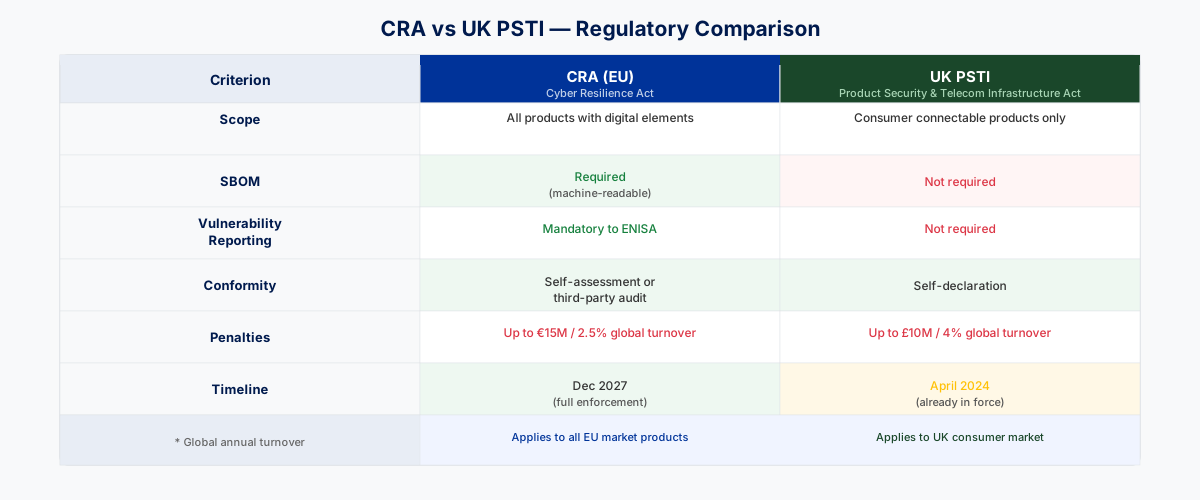
How CRA and UK PSTI Differ in Scope
UK PSTI Act
Full name: Product Security and Telecommunications Infrastructure Act 2022
In force: 29 April 2024
Scope: Consumer connectable products (IoT devices)
Key requirements:
- No universal default passwords
- Provide vulnerability disclosure contact
- Transparency on security update duration
Enforcement: Office for Product Safety and Standards (OPSS)
EU CRA
Full name: Regulation (EU) 2024/2847 (Cyber Resilience Act)
Full application: 11 December 2027
Scope: All products with digital elements (much broader)
Key requirements: Comprehensive security requirements (Annex I)
- Secure by design
- No known exploitable vulnerabilities
- Vulnerability handling
- Security updates for 5+ years
- SBOM requirements
- CE marking
Enforcement: National market surveillance authorities
Side-by-Side Comparison
Scope Comparison
SCOPE COMPARISON

UK PSTI:
+---------------------------------------------+
| Consumer Connectable Products               |
|                                             |
| - Smart TVs, speakers, cameras              |
| - Wearables, smart home devices             |
| - Consumer IoT                              |
| - Children's toys with connectivity         |
|                                             |
| EXCLUDES:                                   |
| - B2B products                              |
| - Medical devices                           |
| - Some vehicle types (since 2025)           |
| - Smart meters (other regulation)           |
| - EV charge points                          |
| - Desktops, laptops, tablets without        |
|   cellular connectivity                     |
| (Smartphones, cellular tablets: IN SCOPE)   |
\---------------------------------------------+

EU CRA:
+---------------------------------------------+
| All Products with Digital Elements          |
|                                             |
| - Consumer IoT (same as PSTI)               |
| - B2B products                              |
| - Industrial equipment                      |
| - Software (standalone)                     |
| - Enterprise hardware                       |
| - Network equipment                         |
|                                             |
| EXCLUDES:                                   |
| - Medical devices (MDR applies)             |
| - Vehicles (type-approval)                  |
| - Aviation (separate regulation)            |
| - Open source (non-commercial)              |
\---------------------------------------------+
Requirements Comparison
| Requirement Area | UK PSTI | EU CRA |
|---|---|---|
| No default passwords | ✓ Required | ✓ Required (secure by default) |
| Vulnerability disclosure | ✓ Contact point required | ✓ CVD policy + ENISA reporting |
| Support period transparency | ✓ Must state duration | ✓ Must state (min 5 years) |
| Minimum support period | ✗ No minimum | ✓ 5 years minimum |
| Security by design | ✗ Not explicit | ✓ Comprehensive requirements |
| No known vulnerabilities | ✗ Not explicit | ✓ Required |
| Encryption requirements | ✗ Not required | ✓ Required |
| Access control | ✗ Not required | ✓ Required |
| SBOM | ✗ Not required | ✓ Required |
| Conformity assessment | ✗ Self-declaration | ✓ Self or third-party |
| CE marking | ✗ Not applicable | ✓ Required |
| ENISA reporting | ✗ Not applicable | ✓ Required (24h/72h) |
The Three PSTI Requirements in Detail
UK PSTI SECURITY REQUIREMENTS

REQUIREMENT 1: NO UNIVERSAL DEFAULT PASSWORDS
"Passwords must be unique per device OR
user must set password during setup"

- No factory defaults like "admin/admin"
- Unique password OR forced user setup
- Must not be easily guessable
- Must not be based on public information

CRA EQUIVALENT:
CRA's "secure by default" covers this and more

---------------------------------------------

REQUIREMENT 2: VULNERABILITY DISCLOSURE
"Manufacturer must provide a public point
of contact for reporting security issues"

- Accessible contact information
- Must acknowledge reports
- Must handle reports appropriately

CRA EQUIVALENT:
CRA requires CVD policy PLUS reporting to ENISA

---------------------------------------------

REQUIREMENT 3: SECURITY UPDATE TRANSPARENCY
"Manufacturer must publish the defined
support period for security updates"

- Must state duration at point of sale
- No minimum duration required
- Information must be accessible

CRA EQUIVALENT:
CRA requires this PLUS minimum 5 years support
Where CRA Goes Beyond UK PSTI
Support Period
SUPPORT PERIOD COMPARISON

UK PSTI:
"Must state the minimum security update period"
- No minimum duration specified
- Can be 1 year, 2 years, or any period
- Manufacturer chooses
- Must be clearly communicated

EU CRA (Art. 13(8)):
"The support period shall be at least five years.
Where the product with digital elements is expected
to be in use for less than five years, the support
period shall correspond to the expected use time."
- MINIMUM 5 years in most cases
- Shorter only if expected use time is shorter
- Longer where the product is expected to be in use longer
- Applies from market placement through the support period
- Must be communicated
Vulnerability Handling
VULNERABILITY HANDLING COMPARISON

UK PSTI:
- Public contact for reports ✓
- Handle reports ✓
- No reporting TO authority
- No timeline requirements

EU CRA:
- Public contact ✓
- CVD policy ✓
- REPORT VIA THE SINGLE REPORTING PLATFORM
  (CSIRT coordinator and ENISA):
  - Actively exploited vulnerabilities: 24h early
    warning, 72h notification, final report 14 days
    after a fix or mitigation is available
  - Severe incidents: 24h early warning, 72h
    notification, final report within one month
- Customer notification requirements
- Fix timeline expectations
Technical Requirements
TECHNICAL REQUIREMENTS DEPTH

UK PSTI:
Three specific requirements only:
1. Passwords
2. Disclosure contact
3. Support period statement

EU CRA:
Comprehensive technical requirements:
- Secure by default
- No known vulnerabilities
- Data protection (confidentiality, integrity)
- Access control
- Availability protection
- Minimize attack surface
- Cryptographic requirements
- Audit logging
- Resilience
- Update mechanisms
- And more (Annex I)
Dual-Compliance Strategy
Approach: CRA as Primary Framework
Since CRA is more comprehensive, use it as your primary compliance framework:
DUAL COMPLIANCE STRATEGY

BASE: CRA Compliance
- Implement all CRA requirements
- Meet Annex I essential requirements
- Prepare technical file
- Generate SBOM
- Establish vulnerability handling
- Plan 5-year support

UK PSTI ADDITIONS:
- Verify password requirement met (already covered)
- Verify disclosure contact exists (already covered)
- Add UK-specific support period statement
- UK enforcement authority registration (if required)

RESULT:
CRA compliance automatically satisfies PSTI
Only minor UK-specific additions needed
Documentation Approach
DOCUMENTATION FOR DUAL COMPLIANCE

SHARED DOCUMENTATION:
- Security architecture
- Risk assessment
- Test reports
- SBOM
- Vulnerability handling process
- User documentation (technical content)

UK-SPECIFIC:
- PSTI statement of compliance
- UK support period statement (can match CRA)
- UK-market labeling/packaging requirements

EU-SPECIFIC:
- EU Declaration of Conformity
- CE marking
- Technical file format per CRA
- Reporting process for the ENISA platform and CSIRT coordinator contact
Timeline Considerations
COMPLIANCE TIMELINE

APRIL 2024: UK PSTI in force
↓
11 SEPTEMBER 2026: CRA reporting obligations (Art. 14)
apply, and have applied since that date
↓
NOW: Must comply with PSTI for UK market
     - No default passwords
     - Disclosure contact
     - Support period stated
     And, for products sold in the EU, report actively
     exploited vulnerabilities and severe incidents
     through the ENISA platform

DECEMBER 2027: CRA fully applicable
↓
Full CRA compliance required for EU market
CRA compliance exceeds PSTI requirements
How to Build One Compliance Program for Both Markets
Password Requirements
PASSWORD IMPLEMENTATION (Both Markets)

OPTION 1: Unique Factory Password
- Generate unique password per device
- Print on device/packaging
- Store securely (for customer recovery)
- Meets both PSTI and CRA

OPTION 2: Forced User Setup
- No pre-set password
- Require password creation at first use
- Enforce complexity requirements
- Meets both PSTI and CRA

IMPLEMENTATION:
Same approach works for both markets
Document in user guide and technical file
Vulnerability Disclosure
VULNERABILITY DISCLOSURE (Both Markets)

FOR PSTI:
- Public contact (email, web form)
- Acknowledgment process
- Handling procedure

FOR CRA (Additional):
- Formal CVD policy
- ENISA reporting capability
- Customer notification process
- Fix timeline management

IMPLEMENTATION:
Build comprehensive CVD process
- Public security contact ✓ (satisfies PSTI)
- CVD policy ✓ (satisfies CRA)
- ENISA integration ✓ (CRA-specific)

SINGLE PROCESS SERVES BOTH MARKETS
Support Period Statement
SUPPORT PERIOD (Both Markets)

UK PSTI REQUIREMENT:
"State the defined support period"
Example: "Security updates provided until December 2029"

EU CRA REQUIREMENT:
"Support for at least 5 years"
Example: "Security updates provided for minimum 5 years
from the date the product is placed on the market,
until at least December 2032"

UNIFIED STATEMENT:
"This product receives security updates for a minimum
of 5 years from the date the product is placed on the market.
Expected end of security support: [date]

For UK market: Compliant with PSTI Act 2022
For EU market: Compliant with Regulation (EU) 2024/2847"
How UK and EU Enforcement Differ
UK: OPSS
UK ENFORCEMENT

Authority: Office for Product Safety and Standards (OPSS)

Powers:
- Compliance notices
- Stop notices
- Recall notices
- Forfeiture
- Penalties up to £10M or 4% global revenue

Key Contacts:
Website: https://www.gov.uk/government/organisations/office-for-product-safety-and-standards
PSTI info: https://www.gov.uk/guidance/regulations-consumer-connectable-product-security
EU: National Authorities
EU ENFORCEMENT

Authority: National market surveillance authorities
(varies by member state)

Powers (per CRA):
- Corrective measures
- Withdrawal from market
- Recall
- Fines up to EUR 15M or 2.5% global revenue

Coordination:
ADCO (Administrative Cooperation) groups
ENISA for vulnerability handling
Checklist: Dual Market Compliance
DUAL COMPLIANCE CHECKLIST

UK PSTI (Now):
[ ] No universal default passwords implemented
[ ] Public vulnerability contact published
[ ] Support period clearly stated
[ ] UK compliance statement prepared
[ ] OPSS guidance reviewed

EU CRA reporting (Now, since 11 September 2026):
[ ] Vulnerability handling process with ENISA reporting

EU CRA (By Dec 2027):
[ ] All essential requirements (Annex I) addressed
[ ] SBOM generated and maintained
[ ] 5-year support period committed
[ ] Technical file prepared
[ ] Conformity assessment completed
[ ] CE marking applied
[ ] EU Declaration of Conformity signed

SHARED:
[ ] Password security implemented (covers both)
[ ] Vulnerability disclosure contact (covers both)
[ ] Support period communicated (meets both)
[ ] User documentation (adapted per market)
[ ] Security testing completed
Official CRA and PSTI Resources
REGULATORY RESOURCES

UK PSTI:
Act: https://www.legislation.gov.uk/ukpga/2022/46
Guidance: https://www.gov.uk/guidance/regulations-consumer-connectable-product-security
OPSS: https://www.gov.uk/government/organisations/office-for-product-safety-and-standards

EU CRA:
Regulation: https://eur-lex.europa.eu/legal-content/EN/TXT/
            ?uri=CELEX:32024R2847
EC Page: https://digital-strategy.ec.europa.eu/en/
         policies/cyber-resilience-act

STANDARDS:
ETSI EN 303 645: Consumer IoT security
(Aligns with both PSTI and CRA)
Info: UK PSTI and EU CRA have different scopes. PSTI focuses on consumer IoT security basics; CRA covers ALL products with digital elements, with deeper requirements.
Tip: If you sell in both UK and EU markets, build to CRA standards. PSTI compliance will follow naturally since CRA exceeds PSTI requirements.
FAQ: Dual Compliance
When does PSTI apply to a product sold to business customers?
PSTI targets "consumer connectable products." A product sold exclusively B2B through enterprise channels generally sits outside PSTI scope. The grey area is dual-use hardware (a smart camera sold to both households and small businesses): if the same SKU is ever made available to consumers in the UK, PSTI applies. Document the distribution route per SKU and keep evidence that the consumer-facing path is closed if you want to argue PSTI does not apply. CRA still applies either way for EU placement.
Can one vulnerability disclosure process satisfy both CRA and PSTI?
Yes, if you build it to the higher bar. PSTI requires a public reporting contact and a handling process. CRA requires a documented coordinated vulnerability disclosure policy (Annex I, Part II(5)), a single point of contact (Article 13(17)), and reporting to the national CSIRT via the ENISA Single Reporting Platform within 24h/72h (Article 14). A CRA-grade CVD process automatically covers PSTI. The reverse is not true. Publish one security.txt, one policy, and one intake workflow, then add the ENISA reporting step for EU-market products.
How should support-period statements differ for UK and EU packaging?
The wording differs, not the underlying commitment. UK PSTI requires you to state the defined minimum period at point of sale, and any duration is legal as long as it is clear. CRA (Art. 13(8)) requires at least 5 years, or the expected product lifetime if shorter. If you commit to 5+ years across the board, you can use a single statement on shared packaging ("Security updates until [date]"). If you offer shorter UK support, you need separate UK-facing copy and cannot reuse EU packaging.
What changes if the same device is sold through distributors in both markets?
Obligations attach to the economic operator placing the product on each market. A UK distributor importing from an EU manufacturer takes on importer duties under PSTI, including verifying the statement of compliance and labelling. An EU importer or distributor carries CRA Art. 19/20 duties. If you are the manufacturer, you still need to hand each distributor the right compliance artifacts for their market: PSTI statement of compliance for UK, EU Declaration of Conformity and technical file reference for EU. Write this into distribution contracts.
Does CE marking help with PSTI compliance in any way?
No. CE is an EU-only mark and has no legal effect in Great Britain post-Brexit. PSTI compliance is evidenced by a statement of compliance accompanying the product, not by a mark. Placing CE on a UK-market product neither helps nor hurts PSTI, but UKCA marking is separate again (and not required by PSTI itself). Do not rely on CE as proof of PSTI compliance during OPSS enforcement.
What extra checks are needed for Northern Ireland placement?
NI is the complicated case. Under the Windsor Framework, goods placed on the NI market must meet EU rules, so CRA applies to NI placement once in force, even though NI is part of the UK. PSTI applies to GB (England, Scotland, Wales) but not NI. If the same SKU goes to both GB and NI, you need both PSTI compliance (for GB) and CRA compliance (for NI). Track placement per market in your batch/lot records so an OPSS or EU authority investigation can be answered with route-of-placement evidence.
Related Articles
Does the CRA apply to your product?
Answer up to 11 simple questions to find out if your product falls under the EU Cyber Resilience Act scope. Get your result in under 2 minutes.
Ready to achieve CRA compliance?
Start managing your SBOMs and compliance documentation with CRA Evidence.