EU Cyber Resilience Act: Complete Implementation Timeline 2025-2027
A comprehensive guide to CRA enforcement deadlines, what manufacturers need to prepare at each stage, and industry-specific compliance checklists.

In this article
The EU Cyber Resilience Act (Regulation 2024/2847) represents the most significant cybersecurity legislation for products with digital elements (PDEs) in the European Union. With enforcement beginning in 2025 and full compliance required by December 2027, manufacturers need to understand the timeline and prepare accordingly.
This guide breaks down each milestone, provides actionable preparation checklists, and offers industry-specific guidance to help you navigate the compliance journey.
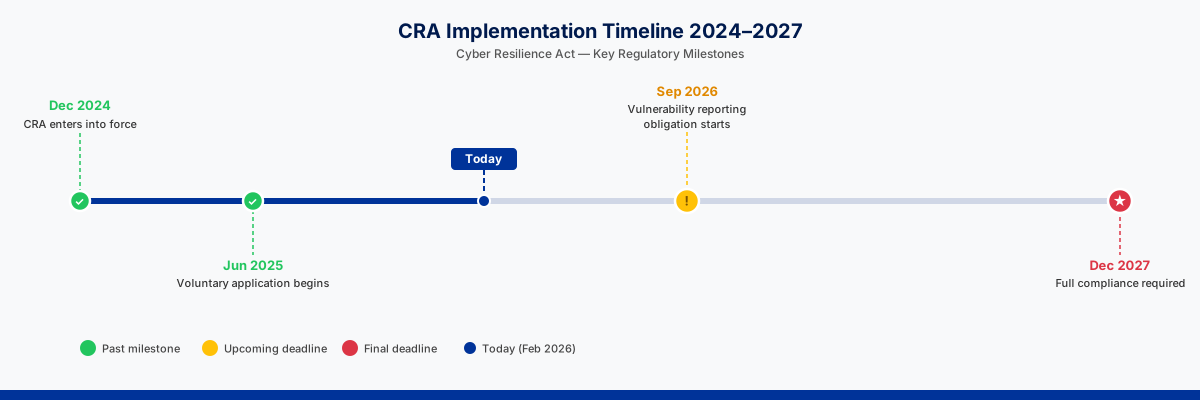
Key Dates at a Glance
| Date | Milestone | Impact |
|---|---|---|
| December 2024 | CRA enters into force | Regulation officially begins |
| September 2026 | Vulnerability reporting begins | 24-hour ENISA notification required |
| December 2027 | Full enforcement | All PDEs must be compliant |
Warning: September 2026 is the first hard deadline. Vulnerability reporting to ENISA becomes mandatory — manufacturers must be ready to report actively exploited vulnerabilities within 24 hours.
Phase 1: Now Until September 2026
This is your preparation window. While there are no enforcement obligations yet, this period is critical for building the foundations of compliance.
What You Should Be Doing Now
1. Product Inventory and Classification
Start by cataloging every product with digital elements you place on the EU market:
- Consumer IoT devices (smart home, wearables, appliances)
- Industrial equipment with network connectivity
- Software products sold or distributed in the EU
- Embedded systems and firmware
For each product, determine its CRA classification (Default, Important Class I, Important Class II, or Critical) as this affects your conformity assessment requirements.
2. SBOM Infrastructure
Tip: Start with SBOM generation. It's the foundation for vulnerability monitoring and provides immediate compliance value.
Software Bills of Materials are mandatory under the CRA. Build your SBOM capability now:
- Integrate SBOM generation into your CI/CD pipeline
- Choose a standard format (CycloneDX or SPDX)
- Ensure coverage of transitive dependencies
- Establish SBOM storage and version tracking
3. Vulnerability Monitoring Setup
Before the September 2026 deadline, establish your vulnerability detection capability:
- Subscribe to vulnerability databases (NVD, OSV, vendor advisories)
- Implement automated scanning of your SBOM components
- Create internal escalation procedures
- Test your notification workflows
Phase 1 Preparation Checklist
PHASE 1 CHECKLIST (Now - September 2026)

PRODUCT INVENTORY:
[ ] Complete list of PDEs sold in EU
[ ] CRA classification for each product
[ ] Identify products requiring third-party assessment
[ ] Document current support period commitments

SBOM FOUNDATION:
[ ] SBOM generation tool selected and integrated
[ ] Format standardized (CycloneDX/SPDX)
[ ] Transitive dependency coverage verified
[ ] Version-controlled SBOM storage established

VULNERABILITY READINESS:
[ ] Monitoring systems in place
[ ] Internal escalation procedures documented
[ ] ENISA notification templates prepared
[ ] Test incident response workflow

DOCUMENTATION BASELINE:
[ ] Existing technical documentation audited
[ ] Gap analysis against Annex VII requirements
[ ] Risk assessment methodology selected
[ ] Documentation templates created
Phase 2: September 2026 - Vulnerability Reporting Active
The first major compliance deadline arrives in September 2026, when vulnerability reporting obligations take effect for all manufacturers.
The 24-Hour Rule
From September 2026, any actively exploited vulnerability in your products must be reported to ENISA within 24 hours of discovery. This is not a suggestion; it's a legal requirement.
The reporting timeline breaks down as follows:
| Timeframe | Requirement | Content |
|---|---|---|
| 24 hours | Initial notification | Basic vulnerability info, affected products |
| 72 hours | Detailed report | Technical analysis, severity assessment |
| 14 days | Progress update | Mitigation status, patch timeline |
| 30 days | Final report | Complete incident analysis, lessons learned |
What "Actively Exploited" Means
A vulnerability is considered actively exploited when there is reliable evidence that malicious code has been executed by an attacker on a system without permission of the system owner. This includes:
- Confirmed attacks in the wild
- Proof-of-concept with evidence of active use
- Exploitation reported by security researchers
- Detection in honeypots or threat intelligence feeds
Preparing Your Vulnerability Workflow
To meet these strict deadlines, you need robust processes:
Internal Detection
- Security monitoring on deployed products
- Bug bounty program responses
- Internal security testing discoveries
External Sources
- CVE database alerts
- Vendor security advisories
- Customer-reported issues
- Security researcher disclosures
Escalation Path
- Define who can trigger a 24-hour notification
- Pre-approve notification templates
- Establish weekend/holiday coverage
- Create backup contacts for key personnel
Phase 2 Checklist
PHASE 2 CHECKLIST (September 2026 Active)

ENISA REPORTING:
[ ] ENISA notification account registered
[ ] Templates approved and ready
[ ] 24/7 escalation path established
[ ] Legal review of notification process completed

VULNERABILITY MANAGEMENT:
[ ] Active monitoring for all products
[ ] CVE/NVD integration operational
[ ] Internal security advisory process active
[ ] Customer notification templates ready

COORDINATION:
[ ] Security team trained on CRA requirements
[ ] Management escalation procedures documented
[ ] Legal team briefed on reporting obligations
[ ] PR/communications prepared for disclosures
Phase 3: December 2027 - Full Compliance
By December 2027, all products with digital elements placed on the EU market must fully comply with CRA requirements. This is the hard deadline, and non-compliant products cannot be legally sold in the EU after this date.
Essential Cybersecurity Requirements (Annex I)
Every compliant product must demonstrate:
Security by Design
- Appropriate security level based on risk assessment
- Protection against unauthorized access
- Confidentiality of stored, transmitted, and processed data
- Integrity of data, commands, and configurations
- Availability of essential functions
Secure Defaults
- Products delivered in secure configuration
- Default passwords prohibited (unique per device required)
- Minimal attack surface out of the box
- Security features enabled by default
Update Capability
- Secure and reliable update mechanism
- Separate security updates from feature updates
- User-controlled update preferences
- Update verification and rollback capability
Vulnerability Management
- Process for identifying and documenting vulnerabilities
- Timely remediation of discovered vulnerabilities
- Free security updates for support period
- Coordinated vulnerability disclosure policy
Technical Documentation (Annex VII)
Every product needs a comprehensive technical file that includes:
| Document | Purpose |
|---|---|
| Risk assessment | Identifies and addresses cybersecurity risks |
| SBOM | Complete component inventory with versions |
| Conformity evidence | Demonstrates compliance with Annex I |
| Vulnerability procedures | Documents handling processes |
| Support declaration | Specifies minimum 5-year support period |
Phase 3 Checklist
PHASE 3 CHECKLIST (December 2027 Deadline)

PRODUCT COMPLIANCE:
[ ] All products meet Annex I requirements
[ ] Conformity assessments completed
[ ] CE marking applied correctly
[ ] EU Declaration of Conformity prepared

TECHNICAL FILE:
[ ] Risk assessment documentation complete
[ ] SBOM current and validated
[ ] Conformity evidence organized
[ ] Support period declared (minimum 5 years)

MARKET PLACEMENT:
[ ] Products registered where required
[ ] Importer/distributor chain informed
[ ] Customer-facing documentation updated
[ ] Support infrastructure ready

ONGOING PROCESSES:
[ ] Vulnerability monitoring active
[ ] Update mechanism operational
[ ] Incident response tested
[ ] Annual review scheduled
Product Classification Deep Dive
Your conformity assessment obligations depend on your product classification:
Default Category
Examples: Simple consumer IoT, basic software applications, non-network devices
Assessment: Self-assessment based on internal control
- No third-party involvement required
- You document compliance internally
- Most cost-effective path
Important Class I
Examples: Identity management software, VPNs, network management tools, password managers, browsers
Assessment: Choice of self-assessment with harmonized standards OR third-party assessment
- If harmonized standards exist and you follow them: self-assessment
- Otherwise: third-party certification body required
Important Class II
Examples: Firewalls, intrusion detection systems, tamper-resistant microprocessors, secure elements
Assessment: Mandatory third-party assessment
- Must use accredited conformity assessment body
- Higher scrutiny and documentation requirements
- Plan for longer assessment timelines
Critical Category
Examples: Smart meters, industrial control systems, hardware security modules (HSMs)
Assessment: EU-type examination required
- Most stringent requirements
- Notified body involvement mandatory
- Expect 6-12 months for assessment process
Industry-Specific Guidance
Consumer Electronics Manufacturers
Timeline priority: Focus on SBOM automation first. Consumer products typically have complex supply chains with multiple component vendors.
Key challenge: Managing firmware updates across diverse device populations. Establish OTA update infrastructure early.
Quick win: Start with one product line as a pilot for CRA compliance, then scale processes to your full portfolio.
Software Publishers
Timeline priority: Vulnerability reporting processes are most critical. Software vulnerabilities are discovered more frequently than hardware issues.
Key challenge: Tracking dependencies in modern software stacks with hundreds of transitive dependencies.
Quick win: Integrate SBOM generation into existing CI/CD pipelines. This provides immediate value for security and compliance.
Industrial Equipment Makers
Timeline priority: Product classification and third-party assessment planning. Industrial products often fall into Important Class II or Critical categories.
Key challenge: Long product lifecycles (10-20 years) meeting 5-year minimum support requirements.
Quick win: Document existing security features. Industrial equipment often has security measures that just need formal documentation.
IoT Device Manufacturers
Timeline priority: Secure update mechanisms and default credential elimination.
Key challenge: Resource-constrained devices may struggle with security update requirements.
Quick win: Address default password issue immediately. It's a clear CRA violation and relatively straightforward to fix.
Common Pitfalls to Avoid
Important: The December 2027 deadline may seem far away, but third-party assessments can take 4-10 months. Products requiring Notified Body involvement need to start NOW.
Starting Too Late
The December 2027 deadline seems far away, but:
- Technical file preparation takes 6-12 months
- Third-party assessments can take 3-6 months
- Process changes need time to embed
- Supply chain updates require coordination
Underestimating SBOM Requirements
A simple list of direct dependencies is not sufficient. The CRA requires:
- Complete transitive dependencies
- Accurate version information
- Machine-readable format
- Regular updates as products change
Ignoring the Support Period
The minimum 5-year support commitment means:
- Security updates for at least 5 years
- Vulnerability response for 5 years
- Documentation retention for 5 years
- Budget and resource planning accordingly
How CRA Evidence Helps
CRA Evidence provides a complete platform for managing your CRA compliance journey:
- SBOM Management: Upload, validate, and maintain SBOMs with TR-03183 quality scoring
- Vulnerability Tracking: Automatic scanning with ENISA deadline tracking and 24-hour alerts
- Technical File Export: Generate Annex VII-compliant documentation bundles
- Compliance Dashboard: Track readiness across your entire product portfolio
- Audit Trail: Full traceability for conformity assessments and vulnerability responses
The December 2027 deadline may seem distant, but building compliant processes takes time. Start your CRA readiness assessment today.
Classification: Determine your product category with our product classification guide.
SBOM: Build your SBOM infrastructure with our SBOM requirements guide.
Reporting: Learn about the 24-hour rule in our ENISA vulnerability reporting guide.
This article is for informational purposes only and does not constitute legal advice. For specific compliance guidance, consult with qualified legal counsel.
Topics covered in this article
Related Articles
Are Smart Cameras Important Products Under the EU Cyber...
Smart security cameras are classified as Important Products (Class I) under...
9 minEU Cybersecurity Act 2: Supply Chain Bans, Certification...
On January 20, 2026, the EU proposed replacing the Cybersecurity Act...
10 minCRA Product Classification: Is Your Product Default,...
A practical guide to determining your product's CRA category. Includes...
11 minDoes the CRA apply to your product?
Answer 6 simple questions to find out if your product falls under the EU Cyber Resilience Act scope. Get your result in under 2 minutes.
Ready to achieve CRA compliance?
Start managing your SBOMs and compliance documentation with CRA Evidence.